19 Cheshvan 5781 l November 6, 2020
Parshat Vayeira
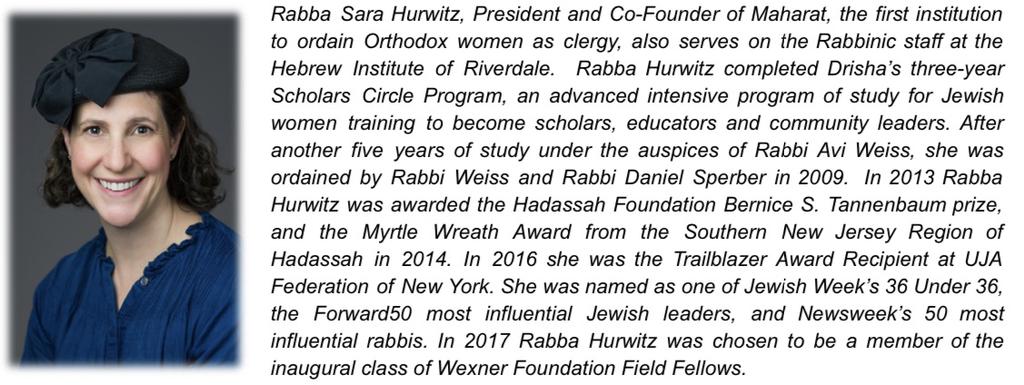
Rabba Sara Hurwitz
President and Co-Founder
This is a parsha of seeing. Its very name is for the opening pasuk- God appeared וירא אליו - evokes imagery of seeing. And the theme is carried through the parsha.
Four times in the akeida story, for example, the root vayeira, is repeated, beginning with “vayisa Avraham et eynav va’yar - Avraham lifted up his eyes and saw.
But there is one moment in the middle of these stories of seeing that is about losing our ability to see.
It’s a disturbing story. Lot welcomes guests into his home. A mob hears of this infraction and appear at Lot’s door. Lot, the consummate host, tries to quiet the mob by offering up his daughters. But, Lot’s guests, God’s angels, come to the rescue and strike the angry mob with blindness: הכו בסנוורים.
And in the confusion, Lot and his family were able to escape from Sodom.
I wonder about the plague of blindness. Why did the Angels close their eyes, as opposed to striking them with boils or cutting off their limbs? The hyper focus on unseeing cannot be ignored.
You see, there is something unbecoming that is going on not only in Sodom, but in Lot’s home, that is being revealed.
Indeed, the Midrash Tanhuma (36) is shocked: A father, the midrash says, is supposed to protect his children, and here he is willing to give them up to be abused? Something is awry in that home.
Indeed, the Midrash Tanhuma (36) is shocked: A father, the midrash says, is supposed to protect his children, and here he is willing to give them up to be abused? Something is awry in that home.
And so, the Torah offers a critique in the form of blindness, a metaphor for the blind eye that we turn when we don’t want to confront something terrible - even abuse - that is right in front of us.
Recently, a friend described her terrible experience of domestic abuse. She told me the story after she was finally able to break free and leave. The abuse happened behind closed doors, where no one could see. And yet, she explained, there were signs that we ignored. I have lived in this religious community my entire life, she told me. I am smart and accomplished, a self-defined feminist. But I did not have the courage to tell anyone. I didn't think anyone would believe me. I did not go to the police because I did not want to create unrest and havoc for my children. And there was a pandemic. And so, I kept quiet. But, she said, there were signs, and no one asked.
There were signs, and I did not ask. Why was she leaving her home in such a hurry? Why did she seem anxious and nervous? I should have asked, but I was blind. Blind, because we tell ourselves, abuse does not happen here, in this community.
In our story, the mefarshim generally agree that the men of Sodom were not physically and eternally struck with blindness. But they were somehow metaphorically blinded. An array of interpretations on the word סנוורים, ַthe word for blindness, were offered.
For the Ibn Ezra, it was a blindness that מחשך העין והלב that causes the darkening of the eyes and heart. It is the blindness of ambivalence, where one can see reality, but the heart is hardened. We close our eyes, and our inaction allows abuse to continue.
Rashi has two interpretations. In our story, סנוורים ַis understood as: מכת עוורון a reference to being blinded with light or a blind spot. It is a blindness where you can see everything else clearly but are blinded by the charisma of the accused abuser; perhaps, they are a communal leader, or an upstanding member of the community. The light the abuser sheds blinds us to the destruction ensuing in front of our eyes.
Rashi has another interpretation. In the story of Elisha the prophet, in Melachim bet (6:18), Elisha prays that God should strike his enemies with blindness, the same word is used, and there Rashi explains that
סַנְוֵרִים. חֹלִי שֶׁל שִׁמָּמוֹן, רוֹאֶה וְאֵינוֹ יוֹדֵעַ מַה הוּא רוֹאֶה.
With blindness. A sickness of confusion; one sees, yet does not know what he sees.
A confounding blindness, where you know what is happening, but you don't know what to do, what to say, and how to help.
Domestic abuse is real. An average of 24 people per minute are victims. And anecdotal evidence suggests that there has been an increase of domestic abuse during the pandemic.
And so, it is time for a communal reckoning. We have to get back to seeing, to the experience of vayisa Avraham et eynav va’yar- of lifting up our eyes and confronting that which is right in front of us. We must do so first by recognizing that the problem is right here in our backyards. Then, we must educate ourselves on the facts. Abuse is often about control and comes in many forms: financial abuse, sexual abuse, physical abuse and emotional abuse. Then, we must recognize the many variable signs: of control, of forced isolation, of public insults, of fear and erratic behavior in victims.
And finally, we must have the courage to ask. To not be silent when we see something awry inside our friends' homes.
Please know that I am trying, learning and growing. If you are struggling, or know someone who is struggling, there are resources. Contact one of the rabbis, a mental health professional or someone you trust. I have also posted organizations that can offer help and support.
This is a heavy topic on what feels like a heavy shabbat. But I hope we can help one another cure ourselves from this communal plague of blindness. And learn, once again, to truly see.
| Shalom Task Force | Met Council Famiy Violence Services | The Jewish Coalition Against Domestic Abuse (JCADA) | ORA (Organization for Resolution of Agunot) |
| (718) 337-3700 | (212) 453-9618 | (877) 88-JCADA | (844) 673-5463 |
| (888) 883-2323 |
Watch it here: