
Save "Sources for Mishne Halachos

Volume 6 Siman 314
"
Sources for Mishne Halachos Volume 6 Siman 314

תנו רבנן כשחלה רבי יוסי בן קיסמא הלך רבי חנינא בן תרדיון לבקרו אמר לו חנינא אחי (אחי) אי אתה יודע שאומה זו מן השמים המליכוה שהחריבה את ביתו ושרפה את היכלו והרגה את חסידיו ואבדה את טוביו ועדיין היא קיימת ואני שמעתי עליך שאתה יושב ועוסק בתורה [ומקהיל קהלות ברבים] וספר מונח לך בחיקך

אמר לו מן השמים ירחמו אמר לו אני אומר לך דברים של טעם ואתה אומר לי מן השמים ירחמו תמה אני אם לא ישרפו אותך ואת ספר תורה באש

אמר לו רבי מה אני לחיי העולם הבא אמר לו כלום מעשה בא לידך אמר לו מעות של פורים נתחלפו לי במעות של צדקה וחלקתים לעניים אמר לו אם כן מחלקך יהי חלקי ומגורלך יהי גורלי

אמרו לא היו ימים מועטים עד שנפטר רבי יוסי בן קיסמא והלכו כל גדולי רומי לקברו והספידוהו הספד גדול ובחזרתן מצאוהו לרבי חנינא בן תרדיון שהיה יושב ועוסק בתורה ומקהיל קהלות ברבים וס"ת מונח לו בחיקו הביאוהו וכרכוהו בס"ת והקיפוהו בחבילי זמורות והציתו בהן את האור והביאו ספוגין של צמר ושראום במים והניחום על לבו כדי שלא תצא נשמתו מהרה

אמרה לו בתו אבא אראך בכך אמר לה אילמלי אני נשרפתי לבדי היה הדבר קשה לי עכשיו שאני נשרף וס"ת עמי מי שמבקש עלבונה של ס"ת הוא יבקש עלבוני

אמרו לו תלמידיו רבי מה אתה רואה אמר להן גליון נשרפין ואותיות פורחות אף אתה פתח פיך

ותכנס בך האש אמר להן מוטב שיטלנה מי שנתנה ואל יחבל הוא בעצמו

אמר לו קלצטונירי רבי אם אני מרבה בשלהבת ונוטל ספוגין של צמר מעל לבך אתה מביאני לחיי העולם הבא אמר לו הן השבע לי נשבע לו מיד הרבה בשלהבת ונטל ספוגין של צמר מעל לבו יצאה נשמתו במהרה אף הוא קפץ ונפל לתוך האור יצאה בת קול ואמרה רבי חנינא בן תרדיון וקלצטונירי מזומנין הן לחיי העולם הבא בכה רבי ואמר יש קונה עולמו בשעה אחת ויש קונה עולמו בכמה שנים

§ The Sages taught: When Rabbi Yosei ben Kisma fell ill, Rabbi Ḥanina ben Teradyon went to visit him. Rabbi Yosei ben Kisma said to him: Ḥanina my brother, do you not know that this nation has been given reign by a decree from Heaven? The proof is that Rome has destroyed God’s Temple, and burned His Sanctuary, and killed His pious ones, and destroyed His best ones, and it still exists. Evidently, all of this is by Divine decree. And yet I heard about you that you sit and engage in Torah study, and convene assemblies in public, and have a Torah scroll placed in your lap, thereby demonstrating complete disregard for the decrees issued by the Romans. Rabbi Ḥanina ben Teradyon said to him: Heaven will have mercy and protect me. Rabbi Yosei ben Kisma said to him: I am saying reasonable matters to you, and you say to me: Heaven will have mercy? I wonder if the Romans will not burn both you and your Torah scroll by fire. Rabbi Ḥanina ben Teradyon said to him: My teacher, what will become of me? Am I destined for life in the World-to-Come? Rabbi Yosei ben Kisma said to him: Did any special incident occur to you which might serve as an indication? Rabbi Ḥanina ben Teradyon said to him: I confused my own coins that I needed for the festivities of Purim with coins of charity, and I distributed them all to the poor at my own expense. Rabbi Yosei ben Kisma said to him: If that is so, may my portion be of your portion, and may my lot be of your lot. The Sages said: Not even a few days passed before Rabbi Yosei ben Kisma died of his illness, and all of the Roman notables went to bury him, and they eulogized him with a great eulogy. And upon their return, they found Rabbi Ḥanina ben Teradyon, who was sitting and engaging in Torah study and convening assemblies in public, with a Torah scroll placed in his lap. They brought him to be sentenced, and wrapped him in the Torah scroll, and encircled him with bundles of branches, and they set fire to it. And they brought tufts of wool and soaked them in water, and placed them on his heart, so that his soul should not leave his body quickly, but he would die slowly and painfully. His daughter said to him: Father, must I see you like this? Rabbi Ḥanina ben Teradyon said to her: If I alone were being burned, it would be difficult for me, but now that I am burning along with a Torah scroll, He who will seek retribution for the insult accorded to the Torah scroll will also seek retribution for the insult accorded to me. His students said to him: Our teacher, what do you see? Rabbi Ḥanina ben Teradyon said to them: I see the parchment burning, but its letters are flying to the heavens. They said to him: You too should open your mouth and the fire will enter you, and you will die quickly. Rabbi Ḥanina ben Teradyon said to them: It is preferable that He who gave me my soul should take it away, and one should not harm oneself to speed his death. The executioner [kaltzatoniri] said to him: My teacher, if I increase the flame and take off the tufts of wool from your heart, so that you will die sooner and suffer less, will you bring me to the life of the World-to-Come? Rabbi Ḥanina ben Teradyon said to the executioner: Yes. The executioner said: Take an oath for me, that what you say is true. Rabbi Ḥanina ben Teradyon took the oath for him, and the executioner immediately increased the flame and took off the tufts of wool from his heart, causing his soul to leave his body quickly. The executioner too leaped and fell into the fire and died. A Divine Voice emerged and said: Rabbi Ḥanina ben Teradyon and the executioner are destined for the life of the World-to-Come. Upon hearing this, Rabbi Yehuda HaNasi wept and said: There is one who acquires his share in the World-to-Come in one moment, such as the executioner, and there is one who acquires his share in the World-to-Come only after many years of toil, such as Rabbi Ḥanina ben Teradyon.

ואל יחבל עצמו - אור"ת דהיכא שיראים פן יעבירום עובדי כוכבים לעבירה כגון ע"י יסורין שלא יוכל לעמוד בהם אז הוא מצוה לחבל בעצמו כי ההיא דגיטין (דף נז:) גבי ילדים שנשבו לקלון שהטילו עצמם לים (וע"ע תוס' גיטין דף נז: ד"ה קפצו):

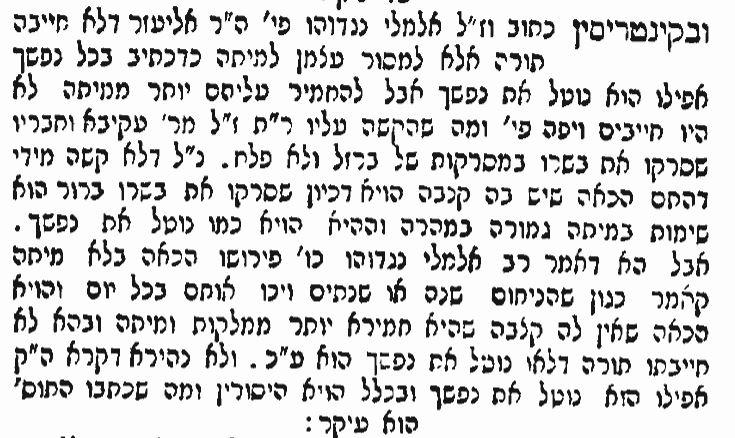
מתקיף לה רב אשי ממאי דמותרה לדבר חמור הוי מותרה לדבר הקל דלמא לא הוי אם תמצא לומר הוי ממאי דמיתה חמורה דלמא מלקות חמור דאמר רב אילמלי נגדוה לחנניה מישאל ועזריה פלחו לצלמא א"ל רב סמא בריה דרב אסי לרב אשי ואמרי לה רב סמא בריה דרב אשי לרב אשי ולא שני לך בין הכאה שיש לה קצבה להכאה שאין לה קצבה
Rav Ashi strongly objects to this proof. First of all, with regard to your initial assumption, from where do you ascertain that one who is forewarned with regard to a severe matter is forewarned with regard to a lesser matter? Perhaps he is not considered forewarned with regard to the lesser matter. Furthermore, even if you say that one is in fact forewarned with regard to a lesser matter, from where do you ascertain that the death penalty is a more severe punishment than lashes? Perhaps the punishment of lashes is more severe, as Rav said: Had they flogged Hananiah, Mishael, and Azariah (see Daniel, chapter 3) instead of casting them into the fiery furnace, these three would have been induced to worship the graven image. Apparently, the punishment of lashes is more severe than death. Rav Samma, son of Rav Asi, said to Rav Ashi, and some say Rav Samma, son of Rav Ashi, said to Rav Ashi: And is there no difference to you between flogging that has a limit, e.g., forty lashes by Torah law, which is a less severe punishment, and flogging that does not have a limit, i.e., flogging administered to induce compliance, which is more severe?

אילמלי נגדוה לחנניה מישאל ועזריה הוו פלחי לצלמא - תימה מנא לן דהא אמרי' בהרואה (ברכות סא:) כשהוציאו את ר"ע אמר כל ימי הייתי מצטער על פסוק זה אימתי יבא לידי ואקיימנו בכל נפשך אלמא משמע דבכל נפשך מיירי אפי' היו מייסרין את האדם ביסורין קשין דומיא דר' עקיבא שהיו מסרקין בשרו במסרקי ברזל וכ"ש לנגודי ואור"ת דאותו צלם לא היה עבודת כוכבים ממש אלא היה עשוי לכבוד המלך ואעפ"כ היה בו קידוש השם ולכך מסרו עצמן למיתה והיינו דכתיב (דניאל ג) לאלהך לית אנן פלחין ולצלם דהבא די אקימת לא נסגוד משמע שהצלם לא היה תופס באלהות ומיהו פלחו לצלמא משמע שהצלם היה עבודת כוכבים מדקאמר פלחו:
כָּל רֶמֶשׂ אֲשֶׁר הוּא חַי, אַךְ בָּשָׂר בְּנַפְשׁוֹ דָּמוֹ (בראשית ט, ג ד), רַבִּי יוֹסֵי בַּר אַיְּבוּ בְּשֵׁם רַבִּי יוֹחָנָן אָדָם הָרִאשׁוֹן שֶׁלֹא הֻתַּר לִבְשַׂר תַּאֲוָה לֹא הֻזְהַר עַל אֵבָר מִן הֶחָי, אֲבָל בְּנֵי נֹחַ שֶׁהֻתְּרוּ לִבְשַׂר תַּאֲוָה הֻזְהֲרוּ עַל אֵבָר מִן הֶחָי. (בראשית ט, ד): אַךְ לְהָבִיא אֶת הַחוֹנֵק עַצְמוֹ, יָכוֹל כְּשָׁאוּל, תַּלְמוּד לוֹמַר אַךְ יָכוֹל כַּחֲנַנְיָה מִישָׁאֵל וַעֲזַרְיָה, תַּלְמוּד לוֹמַר אַךְ. (בראשית ט, ה): מִיַּד כָּל חַיָּה, זֶה הַמּוֹסֵר אֶת חֲבֵרוֹ לְחַיָּה לְהָרְגוֹ. (בראשית ט, ה): מִיַּד אִישׁ אָחִיו, זֶה הַשֹּׂוֹכֵר אֶת אֲחֵרִים לַהֲרֹג אֶת חֲבֵרוֹ. דָּבָר אַחֵר, מִיַּד כָּל חַיָּה אֶדְרְשֶׁנּוּ, אֵלּוּ אַרְבַּע מַלְכֻיּוֹת. מִיַּד הָאָדָם מִיַּד אִישׁ אָחִיו, זֶה עֵשָׂו, דִּכְתִיב (בראשית לב, יב): הַצִּילֵנִי נָא מִיַּד אָחִי מִיַּד עֵשָׂו. אֶדְרשׁ אֶת נֶפֶשׁ הָאָדָם, אֵלּוּ יִשְׂרָאֵל, שֶׁנֶּאֱמַר (יחזקאל לד, יז): וְאַתֵּנָה צֹאנִי (יחזקאל לד, לא): צֹאן מַרְעִיתִי אָדָם אַתֶּם.

אך להביא את החונק עצמו. כי ואך את דמכם לפשותיכם אדרוש יתפרש על המאבד עצמו לדעת. וזה כולל גם החונק את עצמו אשר דמו נשאר בקרבו. והאך בא למעט כשאול אשר ידע שוודאי ימות כי כבר נאמר לו מחר אתה ובניך עמי. אבל אחרים גם אם אויביו יקיפוהו וחרב חדה מונחת על צוארו אסור לו לטרוף את נפשו באפו ולא ימנע עצמו מן הרחמים. כי הקב"ה יציל בחסדו גם הלקוחים למות ומטים להרג:

קטן המאבד עצמו לדעת חשוב כשלא לדעת וכן גדול המאבד עצמו לדעת והוא אנוס כשאול המלך אין מונעין ממנו כל דבר:
A minor who commits suicide wilfullly, is considered as though it were [done] unintentionally. And likewise, one who was of age, and committed suicide wilfully, [being under pressure, as [in the case of] King Saul, — [the law is that] they withhold not from him a thing.
וְנַעְבֵּיד לַהּ חַמֵּי הָאוּר? מִשּׁוּם דְּרַב נַחְמָן, דְּאָמַר רַב נַחְמָן: אָמַר קְרָא: ״וְאָהַבְתָּ לְרֵעֲךָ כָּמוֹךָ״, בְּרוֹר לוֹ מִיתָה יָפָה.
The Gemara challenges: Let us execute her with boiling water heated by fire. The Gemara answers: It is due to the statement of Rav Naḥman, as Rav Naḥman said that the verse states: “And you shall love your fellow as yourself” (Leviticus 19:18). When executing someone, select for him a kind death. Even when someone must be executed, his dignity should be protected. He should be executed in the most comfortable way possible.
עוּלָּא בְּמִיסְּקֵיהּ לְאַרְעָא דְּיִשְׂרָאֵל אִיתְלְווֹ לֵיהּ תְּרֵין בְּנֵי חוֹזָאֵי בַּהֲדֵיהּ קָם חַד שַׁחְטֵיהּ לְחַבְרֵיהּ אֲמַר לֵיהּ לְעוּלָּא יָאוּת עֲבַדִי אֲמַר לֵיהּ אִין וּפְרַע לֵיהּ בֵּית הַשְּׁחִיטָה כִּי אֲתָא לְקַמֵּיהּ דְּרַבִּי יוֹחָנָן אֲמַר לֵיהּ דִּלְמָא חַס וְשָׁלוֹם אַחְזִיקִי יְדֵי עוֹבְרֵי עֲבֵירָה אֲמַר לֵיהּ נַפְשְׁךָ הִצַּלְתָּ
The Gemara relates: Ulla, on his ascent to Eretz Yisrael, had two residents of Ḥozai join him. Because of a brawl between them, one arose and slaughtered the other. The assailant said to Ulla: Did I act properly? He said to him: Yes, and open the place of the slaughter, i.e., cut it more so that he will die faster. When Ulla came before Rabbi Yoḥanan, Ulla said to him: Perhaps, Heaven forbid, I strengthened the hands of sinners by commending him, although I did so merely because I was afraid that he would kill me. He said to him: You saved yourself by doing so, as it is permitted for one to say words like this in order to save his own life.