


Rambam's four steps to teshuva:
1. Recognize and discontinue the improper action.
2. Verbally confess the action, thus giving the action a concrete form in your own mind.
3. Regret the action. Evaluate the negative impact this action may have had on yourself or on others.
4. Determine never to repeat the action. Picture a better way to handle it.
1. Recognize and discontinue the improper action.
2. Verbally confess the action, thus giving the action a concrete form in your own mind.
3. Regret the action. Evaluate the negative impact this action may have had on yourself or on others.
4. Determine never to repeat the action. Picture a better way to handle it.
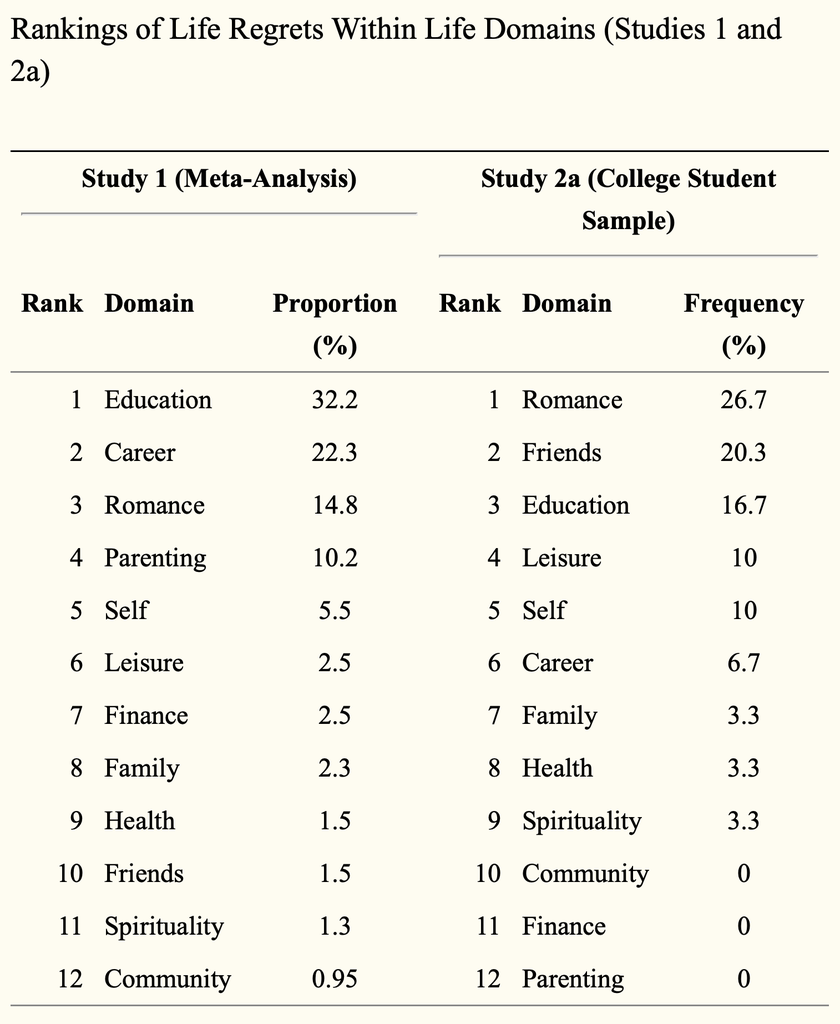
What we regret most … and why (a meta-analysis)
Which domains in life produce the greatest potential for regret, and what features of those life domains explain why? Using archival and laboratory evidence, the authors show that greater perceived opportunity within life domains evokes more intense regret... Overall, these findings show that people’s biggest regrets are a reflection of where in life they see their largest opportunities; that is, where they see tangible prospects for change, growth, and renewal.
Source: https://www.ncbi.nlm.nih.gov/pmc/articles/PMC2394712/
Which domains in life produce the greatest potential for regret, and what features of those life domains explain why? Using archival and laboratory evidence, the authors show that greater perceived opportunity within life domains evokes more intense regret... Overall, these findings show that people’s biggest regrets are a reflection of where in life they see their largest opportunities; that is, where they see tangible prospects for change, growth, and renewal.
Source: https://www.ncbi.nlm.nih.gov/pmc/articles/PMC2394712/

Gilovich, Medvec, and Chen (1995) showed that one reason why regrets of inaction persist longer than regrets of action is that cognitive dissonance reduction is more active for the latter than the former. Regrets of inaction (“Should have asked her out,” “Should have become a dentist”) are more psychologically “open,” more imaginatively boundless, meaning that there is always more one could have done and further riches one might have enjoyed (“She’d have been a wonderful partner,” “It would have been rewarding work”). This openness to possibility (the essence of opportunity) mitigates dissonance reduction. By contrast, regrets of action are psychologically fixed by their factual status and have only one alternative (not doing it). With the consequences of factual action plain as day, cognitive dissonance is more readily aroused to mitigate the sting of those consequences (Gilovich & Medvec, 1995). Thus, regrets of inaction last longer than regrets of action in part because they reflect greater perceived opportunity.
As people grow older, their choices become increasingly constrained. A new romance or a new career are open possibilities for the young but somewhat more difficult for the elderly. Wrosch and Heckhausen (2002) discovered that older individuals produce regrets focusing only rarely on personal action. As their own opportunities fade with advancing years, so too do the most painful and self-recriminating regrets, to be replaced instead by “neutered” regrets that emphasize the actions of other people. In short, this analysis of age effects showed that with diminishing opportunity comes diminished regret.
Does this ring true? Have the kinds of things you regret changed over time?
Does this ring true? Have the kinds of things you regret changed over time?
regret itself spurs corrective action, pushing people to change decision strategies, plans, and behaviors so as to improve their life circumstances (Roese, 1994; Zeelenberg, 1999); such corrective action only makes sense when feasible, that is, when opportunities remain open.
Contemporary Americans have enormous freedom in dating, marriage, and divorce, yet it was not always this way. Might regrets centering on romance be more common today than they were a century ago, when people married young, divorced rarely, and saw few opportunities for alternative romantic partners?
What to do about it
Our research rules out the possibility that framing of the past as high or low in opportunity during this recall stage itself alters the regret experience. [AA: i.e. you can't fool yourself years later by looking back and saying it wouldn't have made a difference. That's not self-forgiveness.]
Consideration of future opportunity in the immediate aftermath of the outcome moderates regret intensity and accordingly whether this regret lingers over longer periods of time.
Our research rules out the possibility that framing of the past as high or low in opportunity during this recall stage itself alters the regret experience. [AA: i.e. you can't fool yourself years later by looking back and saying it wouldn't have made a difference. That's not self-forgiveness.]
Consideration of future opportunity in the immediate aftermath of the outcome moderates regret intensity and accordingly whether this regret lingers over longer periods of time.
Reference: Twelve Life Domains
|