Parashat Hukat
from Likutei Torah
by Rabbi Shneur Zalman of Liadi
Friday June 18, 2021
Translation and Commentary by Rabbi Gedalia Potash and William Schecter, MD
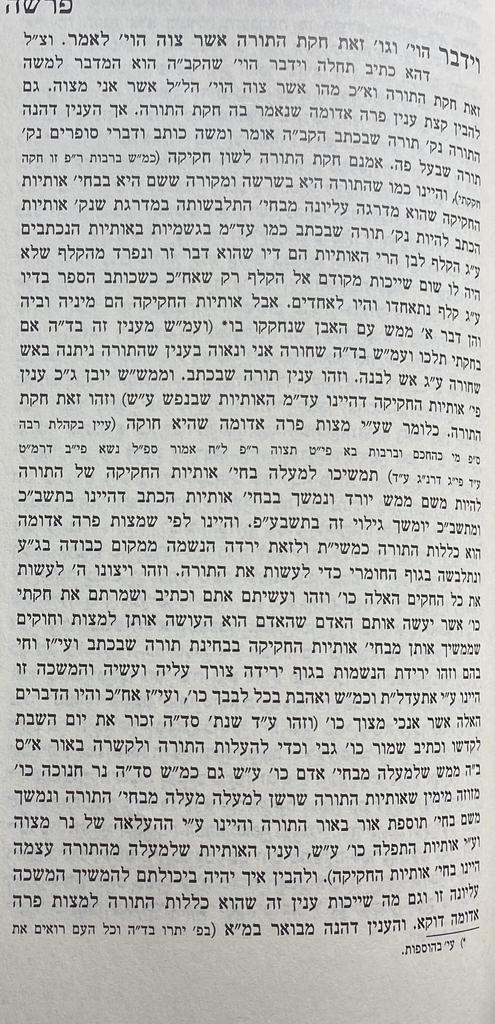
The Elter Rebbe begins his discussion by quoting the first line of this week’s Parashah: “The LORD spoke to Moses and Aaron, saying׃ This is the ritual Statute that the LORD has commanded: Instruct the Israelite people to bring you a red cow without blemish, in which there is no defect and on which no yoke has been laid.”
The Elter Rebbe comments: We must understand that the Torah first says “and G-d spoke” so that G-d is the One who is speaking to Moses saying “this is the Statute of the Torah and if this is so, why does it say “G-d commanded” when It should have said “I commanded”?
We must also understand the conceopt of the Red Heifer and its relation to “the Statute of the Torah”.
Comment: A Red Heifer is sacrificed in the Temple and its parts burned upon the Alter. The ashes are then collected and mixed with pure fresh water flowing from a spring and sprinkled upon a person who has been in contact with the dead, walked over buried corpses or been in the same enclosure with a dead person. So, what is the relationship between the Mitzvah of the Red Heifer and the Torah in general, particularly since the Mitzvah can no longer be carried out since we no longer have a Temple and a Red Heifer is a very rare animal?
A second question arises. Why is the Mitzvah of the Red Heifer called a Statute (Hukah= חוקה) when the remaining 612 commandments in the Torah are called Mitzvot? The Elter Rebbe goes on to explain by separating the Torah into 3 parts: the Written Torah, the Oral Torah and the Ten Commandments engraved into the Stone Tablets.
The Torah is called the Written Torah because G-d is speaking and Moses is writing. In contrast to the scribes who are writing down the words of the Tannaim (the first generations of the Rabbis of the Talmud) which is called the Oral Torah.
Comment: The Talmud teaches that in addition to the Written Torah, the Oral Law (Torah) was transmitted to Moses at Mount Sinai and these teachings were transmitted orally to each generation until they were written down in the third century CE by Yehudah HaNasi and those who followed him.
But the term “the Statute of the Torah” refers to the words engraved (Hakikah) in the Stone Tablets (the Ten Commandments) implying that the Written and Oral Torah, in its Root and Source, has the attributes of engraved letters (in the two Tablets) which is the highest (spiritual) level compared to the letters of the Written Torah. By way example physical letters written upon the white parchment, are composed of ink and which is a separate substance from the parchment to which it has no previous relationship. Only after the scribe writes in ink upon the parchment are the ink and the parchment united. In contrast, the engraved letters are an integral part of the stone in which they are engraved. This is the reason it is called the Statute of the Torah.
Comment: The term Statute (Hukah) of the Torah is derived from the word Hakikah. Hakikah has 3 possible meanings relevant to our discussion. The first relates to rule or law. The second, at least in modern Hebrew, is Constitution. As the Elter Rebbe explains, The Written Torah has a higher spiritual level than the Oral Torah. In a way, one can compare the written Torah to the US Constitution and the Oral Torah to Case Law based on interpretations of the Constitution (if it is valid to compare a Divinely dictated document with a document produced by humans). So, the first two definitions of Hakikah relate to the Law. The third definition of Hakikah is an engraving. The Elter Rebbe explains that the Source of the entire Torah (Hakikat HaTorah-) is the letters engraved in the Stone Tablets) and therefore has the highest spiritual level. The “Written Torah”, that is the Torah written in letters of ink on parchment, is on a lower spiritual level.
Rabbi Potash commented: Superficially, Hakikah (engraving) is much higher than Ktivah (Writing). However, we are reminded that the difference we see is superficial. The letters of the 10 Commandments are engraved. The Written Torah is written and the Oral Torah consists of the discussions of the Rabbis. Even though the Oral Torah is much more distant than the Written Torah, we are trying to unify them and within each is the original wisdom of G-d. Even though there are different ways and stages of revelation of the Torah, the essence is the same.
As if to say that through the Mitzvah of the Red Heifer, which is a Statute (Hukah) you will draw the attribute of these engraved letters of the Torah up (to Supernal Source of the Torah) and from there they will descend and be drawn down into the written letters (on the parchment) of the Written Torah and from the Written Torah they will be drawn to be revealed in the Oral Torah.
This means that the Mitzvah of the Red Heifer is the complete Torah as will be explained and for this the Soul descended from its place of honor in Gan Eden and became invested in the corporeal body in order to do (make) the Torah. “Then the LORD commanded us to observe all these laws” (Deuteronomy 6:24) and “If you follow My laws and faithfully observe My commandments,” (Leviticus 26:3) and it is written “you shall keep my commandments” (Leviticus 18:5) which man will do them -- man is the one who does them, the laws and commandments, and draws them down from the attribute of the engraved letters which are found in the letters in the Written Torah and through this “he lives in them”.
Comment: That is by studying the Written (and the Oral) Torah, one receives the spiritual essence of the supernal Torah engraved in the Stone Tablets.
Rabbi Potash commented: The Mitzvah of Parah Adamah is an example of the kind of connection that is present in all the mitzvot. Parah Adamah is itself a paradox. Why? Because the person who is impure is sprinkled, and then becomes purified. But the person who is doing the sprinkling becomes impure. This is the ultimate paradox. On the one hand the Parah Adamah represents purity, on the other hand—impurity.
When you give of yourself, that is the ultimate sacrifice. The Parah Adumah is the ultimate kindness, giving of yourself, becoming impure to make someone else pure. Just like in life, there are different levels of living. One is taking care of yourself; the other is serving others. In Torah there are aspects that we understand, that are logical, and there are others aspects that are beyond logic—that is the concept of Hakikah—a pure bond of connection that we are trying to reveal and understand. Even the logical areas have a level of spirituality beyond understanding—a true connection.
The purpose of a human being is to come down in to this World and to live by the Torah. The Torah is G-d’s wisdom. Why do we need to have Torah down in the physical world? The idea is not just to have an intellectual concept of G-d but the idea is to incorporate these concepts in our daily life.
G-d as a concept is “almost worthless” if there is not a physical place where we can perform His commandments. Torah is on a high plane but when we incorporate these concepts into our own life, by doing the mitzvot, we make the spiritual truth a physical reality. We are giving fulfillment and purpose to the very idea. An idea which has no implementation is basically worthless. By living Torah, we are bringing G-d into our lives.
G-d commanded us “laasot”- לעשות-to do, to make it happen—we are talking about the statues engraved in the stone. G-d commanded us to do all the mitzvot and to make the hukim part and parcel of the mundane activities of daily life. The physical brings to life all the values of the spiritual.
This is the descent of the Souls in the Body, “a descent for the purpose of ascent”. This drawing down of the essence of the Torah through an “awakening from below”.
Comment: The last sentence contains two key Chassidic concepts:
- Descent for the purpose of ascent—Yerida LeTsorech Aliyah-- ירידה לצורך עליה – refers to the descent of the G-dly soul to be encased in the corporeal body of a person for the purposes of suppressing the Animal Soul and transforming the material to the spiritual allowing it to ascend back to its Supernal Source.
- Awakening from Below-- Itarutah diletahtah-- אתערותא דלתתא—This is an Aramaic term. In Chassidic thought, the descent of the Divine can arouse and transform the material. However, an awakening and yearning from below (that is from us) can stimulate the Divine to descend and engage in a connection with us. This effort on our part is referred to as Awakening from Below. The descent from above and the awakening from below are not mutually exclusive but rather complementary.
How does this Awakening from Below occur? The Elter Rebbe explains by quoting from the Shm’ah
And as it is written ׃ Hear, O Israel! The LORD is our God, the LORD alone.
You shall love the LORD your God with all your heart and with all your soul and with all your might.
Take to heart these instructions with which I charge you this day.
Impress them upon your children. Recite them when you stay at home and when you are away, when you lie down and when you get up.
Bind them as a sign on your hand and let them serve as a symbol on your forehead;
inscribe them on the doorposts of your house and on your gates.
(Deuteronomy 6:4-9)
Our discussion ended at this point. I have included the entire first paragraph of the Sh’mah Prayer because it is directly relevant to this discussion. Reading it carefully in English and thinking about what it means will help clarify the Elter Rebbe’s argument.