


Footnote Lovers' Dream
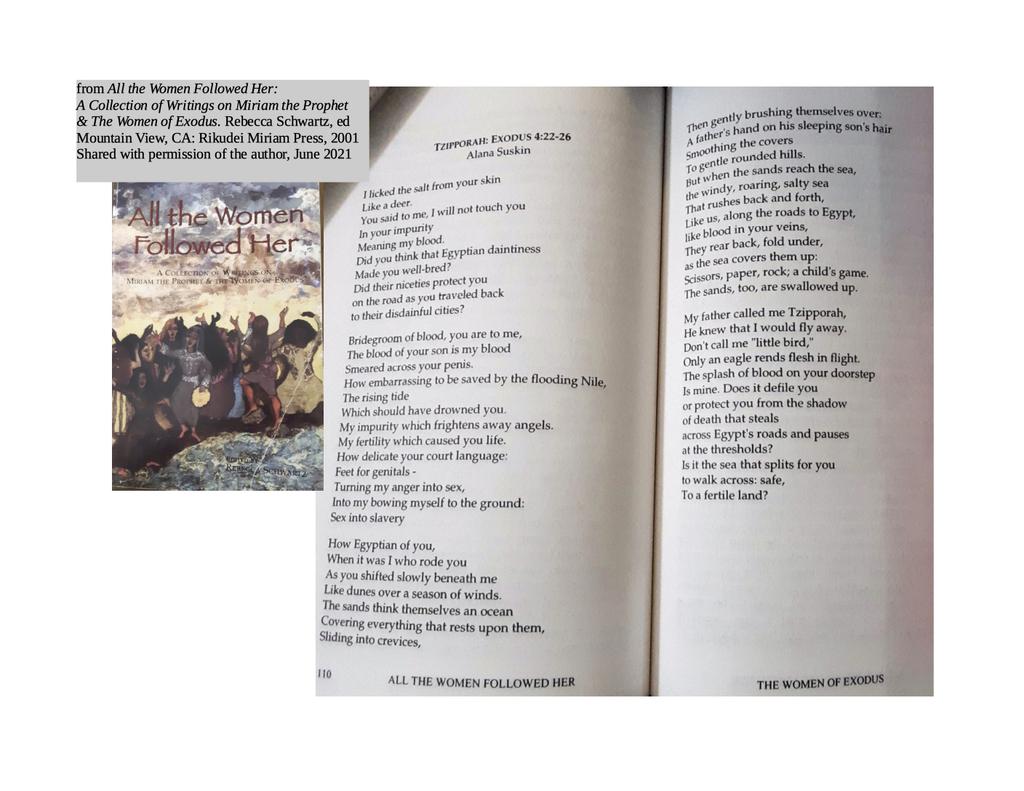
Zipporah (also: Tzipporah) is a footnote-lovers’ dream. She appears only three or four times in the Torah: she is called by name only in Ex 2:21, Ex 4:25, and Ex 18:2 and is possibly the “Cushite” woman who is the focus of Numbers chapter 12. Yet it is this marginal character who stares down God (or a messenger thereof) in order to save her family–and, as a result, the Israelites. In three short verses, a woman who lives largely in the footnotes, or in the white space between the Torah’s letters, makes possible the redemption of the Israelites and the birth of the Jews.
Miriam is closely connected with her brother’s life, even before it begins: In midrash, she is responsible for insisting, at age 6, that the Hebrew couples (including her parents) who had separated during Pharaoh’s decree, remarry and produce childrenamong whom is Moses (Sotah 12a). She follows her brother’s passage down the Nile, is there to offer a wet-nurse to Pharaoh’s daughter (Ex 2:4-7).
Zipporah (also: Tzipporah) is a footnote-lovers’ dream. She appears only three or four times in the Torah: she is called by name only in Ex 2:21, Ex 4:25, and Ex 18:2 and is possibly the “Cushite” woman who is the focus of Numbers chapter 12. Yet it is this marginal character who stares down God (or a messenger thereof) in order to save her family–and, as a result, the Israelites. In three short verses, a woman who lives largely in the footnotes, or in the white space between the Torah’s letters, makes possible the redemption of the Israelites and the birth of the Jews.
Miriam is closely connected with her brother’s life, even before it begins: In midrash, she is responsible for insisting, at age 6, that the Hebrew couples (including her parents) who had separated during Pharaoh’s decree, remarry and produce childrenamong whom is Moses (Sotah 12a). She follows her brother’s passage down the Nile, is there to offer a wet-nurse to Pharaoh’s daughter (Ex 2:4-7).
(כא) וַיּ֥וֹאֶל מֹשֶׁ֖ה לָשֶׁ֣בֶת אֶת־הָאִ֑ישׁ וַיִּתֵּ֛ן אֶת־צִפֹּרָ֥ה בִתּ֖וֹ לְמֹשֶֽׁה׃
(21) Moses consented to stay with the man, and he gave Moses his daughter Zipporah as wife.
(כד) וַיְהִ֥י בַדֶּ֖רֶךְ בַּמָּל֑וֹן וַיִּפְגְּשֵׁ֣הוּ יְהֹוָ֔ה וַיְבַקֵּ֖שׁ הֲמִיתֽוֹ׃ (כה) וַתִּקַּ֨ח צִפֹּרָ֜ה צֹ֗ר וַתִּכְרֹת֙ אֶת־עׇרְלַ֣ת בְּנָ֔הּ וַתַּגַּ֖ע לְרַגְלָ֑יו וַתֹּ֕אמֶר כִּ֧י חֲתַן־דָּמִ֛ים אַתָּ֖ה לִֽי׃ (כו) וַיִּ֖רֶף מִמֶּ֑נּוּ אָ֚ז אָֽמְרָ֔ה חֲתַ֥ן דָּמִ֖ים לַמּוּלֹֽת׃ {פ}
(24) At a night encampment on the way, the LORD encountered him and sought to kill him. (25) So Zipporah took a flint and cut off her son’s foreskin, and touched his legs with it, saying, “You are truly a bridegroom of blood to me!” (26) And when He let him alone, she added, “A bridegroom of blood because of the circumcision.”
(ב) וַיִּקַּ֗ח יִתְרוֹ֙ חֹתֵ֣ן מֹשֶׁ֔ה אֶת־צִפֹּרָ֖ה אֵ֣שֶׁת מֹשֶׁ֑ה אַחַ֖ר שִׁלּוּחֶֽיהָ׃ (ג) וְאֵ֖ת שְׁנֵ֣י בָנֶ֑יהָ אֲשֶׁ֨ר שֵׁ֤ם הָֽאֶחָד֙ גֵּֽרְשֹׁ֔ם כִּ֣י אָמַ֔ר גֵּ֣ר הָיִ֔יתִי בְּאֶ֖רֶץ נׇכְרִיָּֽה׃ (ד) וְשֵׁ֥ם הָאֶחָ֖ד אֱלִיעֶ֑זֶר כִּֽי־אֱלֹהֵ֤י אָבִי֙ בְּעֶזְרִ֔י וַיַּצִּלֵ֖נִי מֵחֶ֥רֶב פַּרְעֹֽה׃ (ה) וַיָּבֹ֞א יִתְר֨וֹ חֹתֵ֥ן מֹשֶׁ֛ה וּבָנָ֥יו וְאִשְׁתּ֖וֹ אֶל־מֹשֶׁ֑ה אֶל־הַמִּדְבָּ֗ר אֲשֶׁר־ה֛וּא חֹנֶ֥ה שָׁ֖ם הַ֥ר הָאֱלֹהִֽים׃
(2) So Jethro, Moses’ father-in-law, took Zipporah, Moses’ wife, after she had been sent home, (3) and her two sons—of whom one was named Gershom, that is to say, “I have been a stranger in a foreign land”; (4) and the other was named Eliezer, meaning, “The God of my father was my help, and He delivered me from the sword of Pharaoh.” (5) Jethro, Moses’ father-in-law, brought Moses’ sons and wife to him in the wilderness, where he was encamped at the mountain of God.
(א) וַתְּדַבֵּ֨ר מִרְיָ֤ם וְאַהֲרֹן֙ בְּמֹשֶׁ֔ה עַל־אֹד֛וֹת הָאִשָּׁ֥ה הַכֻּשִׁ֖ית אֲשֶׁ֣ר לָקָ֑ח כִּֽי־אִשָּׁ֥ה כֻשִׁ֖ית לָקָֽח׃
(1) Miriam and Aaron spoke against Moses because of the Cushite woman he had married: “He married a Cushite woman!”
Thoughts on Zipporah from Umberto Cassuto
...the Lord met him, that means, that he contracted a severe illness (on the Hebrew usage that attributed every event to the direct action of God see my remarks above, p.56)
["In early Hebrew diction, it is customary to attribute every phenomenon to the direct action of God....Every happening has a number of causes, and these causes, in turn have other causes, and so on ad infinitum; according to the Israelite conception, the cause of all causes was the will of God, the Creator and Ruler of the world...." -- p.56]
-- Cassuto, p.60
...three things that can help us to understand the paragraph [Exod 4:24-26] are clear. The first is the fact that a certain resemblance is discernible between the episode narrated here and that described in the section of Balaam with regard to the angel of the Lord, 'who placed himself in the way for an adversary against him', after the Lord had already granted him permission to go. The appearance of the angel can only be understood as a final warning to Balaam, when he set forth on his journey, and as a new reminder of the injunction that only the word that the Lord would speak unto him should be spoken. It may be that our paragraph also comes to tell us of a last warning of this kind, intended to supplement the final directives that had been given to Moses prior to his departure from Midian (vv.21-23).** The nature of the warning will be clarified in exposition that will soon follow.
Secondly, our paragraph is undoubtedly linked (contrary to the view of most modern exegetes) with the paragraph before it and the one after. This is borne out by an expression like and sought to kill him, which recalls the earlier statement in v.19: 'for all the men are dead with sought your life'; by the word [vayifgeseihu] [and met him'], which recurs in the identical form in v.27; and more particularly by the mention of Moses' son in v.25 -- his first-born son, as we have explained -- which forms a parallel to 'My son, My first-born' in v.22, and to 'you son, you first-born' in v.23. The connection to be found between the verses that speak of first-born sons will become immediately apparent in the subsequent annotations.
The third point is that the pivot of the whole story is the circumcision of the child....
-- Cassuto, p58-59
A Commentary on the Book of Exodus by U. Cassuto. Translated from the Hebrew by Israel Abrahams. Jerusalem: Magnes Press 1997 (first published in Hebrew 1951). Moshe David Cassuto (1883 – 1951), an Italian rabbi who was forced to leave Italy in 1938 and settled in Palestine, is known for using a close literary reading of the text in an alternative to the Documentary Hypothesis as it was understood in the early 20th Century.
...the Lord met him, that means, that he contracted a severe illness (on the Hebrew usage that attributed every event to the direct action of God see my remarks above, p.56)
["In early Hebrew diction, it is customary to attribute every phenomenon to the direct action of God....Every happening has a number of causes, and these causes, in turn have other causes, and so on ad infinitum; according to the Israelite conception, the cause of all causes was the will of God, the Creator and Ruler of the world...." -- p.56]
-- Cassuto, p.60
...three things that can help us to understand the paragraph [Exod 4:24-26] are clear. The first is the fact that a certain resemblance is discernible between the episode narrated here and that described in the section of Balaam with regard to the angel of the Lord, 'who placed himself in the way for an adversary against him', after the Lord had already granted him permission to go. The appearance of the angel can only be understood as a final warning to Balaam, when he set forth on his journey, and as a new reminder of the injunction that only the word that the Lord would speak unto him should be spoken. It may be that our paragraph also comes to tell us of a last warning of this kind, intended to supplement the final directives that had been given to Moses prior to his departure from Midian (vv.21-23).** The nature of the warning will be clarified in exposition that will soon follow.
Secondly, our paragraph is undoubtedly linked (contrary to the view of most modern exegetes) with the paragraph before it and the one after. This is borne out by an expression like and sought to kill him, which recalls the earlier statement in v.19: 'for all the men are dead with sought your life'; by the word [vayifgeseihu] [and met him'], which recurs in the identical form in v.27; and more particularly by the mention of Moses' son in v.25 -- his first-born son, as we have explained -- which forms a parallel to 'My son, My first-born' in v.22, and to 'you son, you first-born' in v.23. The connection to be found between the verses that speak of first-born sons will become immediately apparent in the subsequent annotations.
The third point is that the pivot of the whole story is the circumcision of the child....
-- Cassuto, p58-59
A Commentary on the Book of Exodus by U. Cassuto. Translated from the Hebrew by Israel Abrahams. Jerusalem: Magnes Press 1997 (first published in Hebrew 1951). Moshe David Cassuto (1883 – 1951), an Italian rabbi who was forced to leave Italy in 1938 and settled in Palestine, is known for using a close literary reading of the text in an alternative to the Documentary Hypothesis as it was understood in the early 20th Century.

Ilana Pardes. The Biography of Ancient Israel: National Narratives in the Bible.
(Berkeley, CA: University of California Press, 2000)
Zipporah
If Yocheved is the one who most clearly resembles Isis in her role as the suckling goddess, Zipporah, Moses' wife, calls to mind the Winged Savior. Zipporah, one should bear in mind, means "bird" in Hebrew, and this is but one feature that points to her affinity with the goddess. Much like Isis, Zipporah plays the role of a savior, rescuing her husband from the wrath of a persecuting deity. The scene of rescue takes place in a strange dramatic night, right after Moses' initiation by the burning bush. God, who had just sent Moses back to Egypt to do wonders before Pharaoh, and the people, suddenly attacks his messenger at a loding along the road. Zipporah springs out of the dark and intrervenes with unexpected force. She moves swiftly, takes a flint in her hand, circumcises her son, and touches "his feet" (Moses' feet? her son's?) with the foreskin, saying repeatedly: "You are truly a bridegroom of blood to me!") (chatan damim 'ata li; Exod 4:25).62 [YHVH] succumbs to Zipporah's magical act and withdraws, Moses is saved.63
The story of the "Bridegroom of Blood" offers a perplexing counterpart to the episode of the burning bush. Here too, as in the nation's biography, initiation is a process taht requires more than one rite and mroe than one representation. Moses' initial refusal to assume the position of deliverer in Exodus 3 turns into an eerie combat in Exodus 4, for here God's anger is conveyed by means of concrete violence and His insistence on having total possession of the one He had chosen comes close to murder. [-- p. 96, Pardes. The Biography of Ancient Israel]
Zipporah's intervention, however, is the most radical supplement. It seems to suggest that a feminine touch must be added before Moses' initiation can be regarded as complete. Zipporah designates Moses ceremoniously as her "bridegroom of blood" and takes him, as it were, under her wings. Women (and mothers in particular) -- despite, or rather because of, their powerlessness -- often have an important role in teaching the weak and threatened young heroes how to handle hostile paternal figures. Rebekah offers such help to young Jacob in his struggle to assume the position of the chosen firstborn against Isaac's will.
That Zipporah's opponent is the Father Himself makes her move all the more startling. She placates [YHVH] by complying partially and cunningly with His whims. Her strategy is synechdochic: pars pro toto, a foreskin and a touch of blood for the victim's life.64 If she can ward off divine violence she seems to assert, so can Moses. The mission will take its bloody toll....She marks Moses (or her son) with blood, foreshadowing the two scenes in which the nation is marked by blood: on the night of the Exodus and then again on accepting the book of the covenant at Sinai. The history of the poeple is already inscribed on his body and the body of their son. He must go on.
Zipporah is sent off by Moses after this nocturnal episode, and we do not hear of her until she returns to the campe in Exodus 18: "Then Jethro, Moses' father in law, took Zipporah, Moses' wife, after he [Moses] had sent her back" and came with her and her [-- p. 97, Pardes. The Biography of Ancient Israel]
sons "unto Moses into the wilderness, where he encamped at the mount of God (2-5). Why Zipporah was sent back remains a mystery, but her return is even more enigmatic. One can only conjecture that her wings are necessary on this historical occasion in which the nation as a whole is about to undergo an initiation rite as fearful and violent, at points, as the rite of passage in Exodus 4. Perhaps Jethro, who provides Moses with valuable advice during his visit regtarding the distribution of judicial authority, also intimates that neither Moses nor God can do without feminine presence in their respective tents.
The rabbis, in any event, sensed the quest for maternal wings -- on this mountain and beyond it -- and fashioned a female symbol of Divine Presence, called Shekhina.... [-- p. 98, Pardes. The Biography of Ancient Israel]
END NOTES:
62. New JPS translation.*
63. I provide an extensive reading of this strange tale in Countertraditions (chap 5).**
64. See Talmon 1954.***
Above, as appearing in The Biography of Ancient Israel.
Below are amendations from V. Spatz
*This means the 1985, rather than the 1917 -- V. Spatz. The 1985 is still called "New JPS" by many.
**The chapter is too long and complex to summarize or quote sensibly, but here is the conclusion:
Zipporah's representation in Exodus, to use Erich Auerbach's (1953) wonderful expression, is "fraught with bckground"; it demands interpretation. I have tried to provide her with a partial background, but it would require some of Zipporah's magical powers to deliver fully a history that has been so severely curtailed.
-- Ilana Pardes. Countertraditions in the Bible: A Feminist Approach. (Cambridge, MA: Harvard University Press, 1992)
***Talmon, Shemaryahu. 1954. "Hatan Damim." Eretz Yisrael 3:93-95. (from bibliography in The Biography of Ancient Israel.)
Ilana Pardes is Katharine Cornell Professor of Comparative Literature and the director of the Center for Literary Studies, both at the Hebrew University of Jerusalem. She researches the nexus of Bible, literature, and culture as well as aesthetics and hermeneutics. (university bio)
Countertraditions in the Bible is available new through Harvard Univ. Press and used through Biblio and other sources. No ebook, but parts of the Zipporah chapter can be found on Google Books.
https://www.hup.harvard.edu/catalog.php?isbn=9780674175457
The Biography of Ancient Israel is available new, and as ebook, through Univ. of California Press and used through Biblio and other sources. Selections are availble through Google Books.
https://www.ucpress.edu/book/9780520236868/the-biography-of-ancient-israel
(Berkeley, CA: University of California Press, 2000)
Zipporah
If Yocheved is the one who most clearly resembles Isis in her role as the suckling goddess, Zipporah, Moses' wife, calls to mind the Winged Savior. Zipporah, one should bear in mind, means "bird" in Hebrew, and this is but one feature that points to her affinity with the goddess. Much like Isis, Zipporah plays the role of a savior, rescuing her husband from the wrath of a persecuting deity. The scene of rescue takes place in a strange dramatic night, right after Moses' initiation by the burning bush. God, who had just sent Moses back to Egypt to do wonders before Pharaoh, and the people, suddenly attacks his messenger at a loding along the road. Zipporah springs out of the dark and intrervenes with unexpected force. She moves swiftly, takes a flint in her hand, circumcises her son, and touches "his feet" (Moses' feet? her son's?) with the foreskin, saying repeatedly: "You are truly a bridegroom of blood to me!") (chatan damim 'ata li; Exod 4:25).62 [YHVH] succumbs to Zipporah's magical act and withdraws, Moses is saved.63
The story of the "Bridegroom of Blood" offers a perplexing counterpart to the episode of the burning bush. Here too, as in the nation's biography, initiation is a process taht requires more than one rite and mroe than one representation. Moses' initial refusal to assume the position of deliverer in Exodus 3 turns into an eerie combat in Exodus 4, for here God's anger is conveyed by means of concrete violence and His insistence on having total possession of the one He had chosen comes close to murder. [-- p. 96, Pardes. The Biography of Ancient Israel]
Zipporah's intervention, however, is the most radical supplement. It seems to suggest that a feminine touch must be added before Moses' initiation can be regarded as complete. Zipporah designates Moses ceremoniously as her "bridegroom of blood" and takes him, as it were, under her wings. Women (and mothers in particular) -- despite, or rather because of, their powerlessness -- often have an important role in teaching the weak and threatened young heroes how to handle hostile paternal figures. Rebekah offers such help to young Jacob in his struggle to assume the position of the chosen firstborn against Isaac's will.
That Zipporah's opponent is the Father Himself makes her move all the more startling. She placates [YHVH] by complying partially and cunningly with His whims. Her strategy is synechdochic: pars pro toto, a foreskin and a touch of blood for the victim's life.64 If she can ward off divine violence she seems to assert, so can Moses. The mission will take its bloody toll....She marks Moses (or her son) with blood, foreshadowing the two scenes in which the nation is marked by blood: on the night of the Exodus and then again on accepting the book of the covenant at Sinai. The history of the poeple is already inscribed on his body and the body of their son. He must go on.
Zipporah is sent off by Moses after this nocturnal episode, and we do not hear of her until she returns to the campe in Exodus 18: "Then Jethro, Moses' father in law, took Zipporah, Moses' wife, after he [Moses] had sent her back" and came with her and her [-- p. 97, Pardes. The Biography of Ancient Israel]
sons "unto Moses into the wilderness, where he encamped at the mount of God (2-5). Why Zipporah was sent back remains a mystery, but her return is even more enigmatic. One can only conjecture that her wings are necessary on this historical occasion in which the nation as a whole is about to undergo an initiation rite as fearful and violent, at points, as the rite of passage in Exodus 4. Perhaps Jethro, who provides Moses with valuable advice during his visit regtarding the distribution of judicial authority, also intimates that neither Moses nor God can do without feminine presence in their respective tents.
The rabbis, in any event, sensed the quest for maternal wings -- on this mountain and beyond it -- and fashioned a female symbol of Divine Presence, called Shekhina.... [-- p. 98, Pardes. The Biography of Ancient Israel]
END NOTES:
62. New JPS translation.*
63. I provide an extensive reading of this strange tale in Countertraditions (chap 5).**
64. See Talmon 1954.***
Above, as appearing in The Biography of Ancient Israel.
Below are amendations from V. Spatz
*This means the 1985, rather than the 1917 -- V. Spatz. The 1985 is still called "New JPS" by many.
**The chapter is too long and complex to summarize or quote sensibly, but here is the conclusion:
Zipporah's representation in Exodus, to use Erich Auerbach's (1953) wonderful expression, is "fraught with bckground"; it demands interpretation. I have tried to provide her with a partial background, but it would require some of Zipporah's magical powers to deliver fully a history that has been so severely curtailed.
-- Ilana Pardes. Countertraditions in the Bible: A Feminist Approach. (Cambridge, MA: Harvard University Press, 1992)
***Talmon, Shemaryahu. 1954. "Hatan Damim." Eretz Yisrael 3:93-95. (from bibliography in The Biography of Ancient Israel.)
Ilana Pardes is Katharine Cornell Professor of Comparative Literature and the director of the Center for Literary Studies, both at the Hebrew University of Jerusalem. She researches the nexus of Bible, literature, and culture as well as aesthetics and hermeneutics. (university bio)
Countertraditions in the Bible is available new through Harvard Univ. Press and used through Biblio and other sources. No ebook, but parts of the Zipporah chapter can be found on Google Books.
https://www.hup.harvard.edu/catalog.php?isbn=9780674175457
The Biography of Ancient Israel is available new, and as ebook, through Univ. of California Press and used through Biblio and other sources. Selections are availble through Google Books.
https://www.ucpress.edu/book/9780520236868/the-biography-of-ancient-israel
Tzipporah's Eye View -- DC Sermon Slam 2014
I have always lived among priests and prophets. I know that some divine encounters prove more terrifying than illuminating. And I believe there is much to be learned about Revelation by turning away from Sinai’s thunder and lightening.
Consider for a moment that time Miriam and Aaron complained about Moses and his black wife and God responded by covering Miriam with white scales. [Numbers 12:1ff. Tzipporah also appears in Exodus chapters 3, 4, and 18]…
…So, what does this incident tell you about Revelation?
Follow me for a moment on a “tzipporah-eye view,” looking two directions at once to see ahead. [“Tzipporah” = “bird”]
One bird’s eye focuses in on the siblings, without regard to gender. Here are three powerful individuals, all within spitting distance, shall we say, of divine Revelation. Genuine caring and concern between the siblings is evident, and each is deeply committed to community and the evolving Torah.
And yet, this story shows, understanding anyone else’s piece of Revelation – even the teaching of a prophet sibling, whom you love and respect – has always been hard. How much more so must non-siblings in your time work to understand each other’s perspectives!…
Video recording from DC’s 2014 recent Sermon Slam, a project of Open Quorum, as well as full text at "Tzipporah's Eye View."
MORE on ZIPPORAH
Nice review of traditional midrash on this episode in Numbers 12,
from Jewish Women's Archive.
Notes of my own, on songeveryday.org
(Glad they're posted, because I forgot most of it.)
Note on the midrash suggesting Moses’ “cushite wife” is the Torah’s black ink.
Discussion of tzaraat and prophecy
See also "Drawing Back: Zipporah’s View" and "One Woman’s Conclusion," both written originally for Fabrangen Havurah.
In addition, here's a rambling imagining of what Zipporah might have been singing when she and Moses part in Exodus 4.