


ישן עליה...ואשה שמאחרת טבילתה לצער בעלה עבירה גדולה בידה וגרמה כמה רעות. זוהר ע"ת.
וְהָאָמַר רַב יִצְחָק בַּר אַבְדִּימִי: עֶשֶׂר קְלָלוֹת נִתְקַלְּלָה חַוָּה, דִּכְתִיב: ״אֶל הָאִשָּׁה אָמַר הַרְבָּה אַרְבֶּה״, אֵלּוּ שְׁנֵי טִפֵּי דָמִים — אַחַת דַּם נִדָּה, וְאַחַת דַּם בְּתוּלִים. ״עִצְּבוֹנֵךְ״, זֶה צַעַר גִּידּוּל בָּנִים. ״וְהֵרוֹנֵךְ״, זֶה צַעַר הָעִיבּוּר. ״בְּעֶצֶב תֵּלְדִי בָּנִים״, כְּמַשְׁמָעוֹ. ״וְאֶל אִישֵׁךְ תְּשׁוּקָתֵךְ״, מְלַמֵּד שֶׁהָאִשָּׁה מִשְׁתּוֹקֶקֶת עַל בַּעְלָהּ בְּשָׁעָה שֶׁיּוֹצֵא לַדֶּרֶךְ. ״וְהוּא יִמְשׇׁל בָּךְ״, מְלַמֵּד שֶׁהָאִשָּׁה תּוֹבַעַת בַּלֵּב וְהָאִישׁ תּוֹבֵעַ בַּפֶּה. זוֹ הִיא מִדָּה טוֹבָה בַּנָּשִׁים. כִּי קָאָמְרִינַן, דְּמַרְצְיָא אַרְצוֹיֵי קַמֵּיהּ. הָנֵי שֶׁבַע הָוְויָן! כִּי אֲתָא רַב דִּימִי אָמַר: עֲטוּפָה כְּאָבֵל, וּמְנוּדָּה מִכׇּל אָדָם, וַחֲבוּשָׁה בְּבֵית הָאֲסוּרִין. מַאי מְנוּדָּה מִכׇּל אָדָם? אִילֵּימָא מִשּׁוּם דַּאֲסִיר לַהּ יִיחוּד, אִיהוּ נָמֵי אֲסִיר לֵיהּ יִיחוּד. אֶלָּא דַּאֲסִירָא לְבֵי תְרֵי.


(א) הַמּוֹכֵר אֶת הַסְּפִינָה, מָכַר אֶת הַתֹּרֶן וְאֶת הַנֵּס וְאֶת הָעוֹגִין...
(1) One who sells a ship has sold along with it the toren, and the nes, and the ogin {Anchor}...

(1) A man takes a wife and possesses her. She fails to please him because he finds something obnoxious about her, and he writes her a bill of divorcement, hands it to her, and sends her away from his house;
מתני׳ ... וקונה את עצמה בגט ובמיתת הבעל...
MISHNA: .... And a woman acquires herself through a bill of divorce or through the death of the husband...
(א) אֵין הָאִשָּׁה מִתְגָּרֶשֶׁת אֶלָּא בִּכְתָב שֶׁיַּגִּיעַ לָהּ וּכְתָב זֶה הוּא הַנִּקְרָא גֵּט. וַעֲשָׂרָה דְּבָרִים הֵן עִקַּר הַגֵּרוּשִׁין מִן הַתּוֹרָה וְאֵלּוּ הֵן. א) שֶׁלֹּא יְגָרֵשׁ הָאִישׁ אֶלָּא בִּרְצוֹנוֹ. ב) וְשֶׁיְּגָרֵשׁ בִּכְתָב וְלֹא בְּדָבָר אַחֵר. ג) וְשֶׁיִּהְיֶה עִנְיַן הַכְּתָב שֶׁגֵּרְשָׁהּ וֶהֱסִירָהּ מִקִּנְיָנוֹ. ד) וְשֶׁיִּהְיֶה עִנְיָנוֹ דָּבָר הַכּוֹרֵת בֵּינוֹ לְבֵינָהּ. ה) וְשֶׁיִּהְיֶה נִכְתָּב לִשְׁמָהּ. ו) וְשֶׁלֹּא יִהְיֶה מְחֻסַּר מַעֲשֶׂה אַחַר כְּתִיבָתוֹ אֶלָּא נְתִינָתוֹ לָהּ [בִּלְבַד]. ז) וְשֶׁיִּתְּנֵהוּ לָהּ. ח) וְשֶׁיִּתְּנֵהוּ לָהּ בִּפְנֵי עֵדִים. ט) וְשֶׁיִּתְּנֵהוּ לָהּ בְּתוֹרַת גֵּרוּשִׁין. י) וְשֶׁיִּהְיֶה הַבַּעַל אוֹ שְׁלוּחוֹ הוּא שֶׁנּוֹתְנוֹ לָהּ. וּשְׁאָר הַדְּבָרִים שֶׁבַּגֵּט כְּגוֹן הַזְּמַן וַחֲתִימַת הָעֵדִים וְכַיּוֹצֵא בָּהֶן הַכּל מִדִּבְרֵי סוֹפְרִים:
(1) The wife can be divorced only with a written document that comes into her possession; such a document is called get (letter of divorce). There are ten basic things prescribed by the Torah in the divorce proceedings, namely: 1) The get must come from the husband voluntarily. 2) He must prepare it in writing only. 3) The subject of the letter must unfold that he has divorced and removed her from his possession. 4) It must express the idea of separation between him and her. 5) It must be especially written for her. 6) It must not require any other act except delivery. 7) He must hand it to her. 8) He must hand it to her in the presence of witnesses. 9) He must give it to her as a letter of divorce. 10) Only the husband, or his agent, must be the one handing it to her. The rest of the features of a get, such as the date and the signature of the witnesses, and the like, are all rabbinic in origin.
א) צריך שיהיה כתיבתו וחתימתו לשמה ובו ט"ס:
צריך שתהיה כתיבת הגט וחתימתו לשם האיש המגרש ולשם האשה המתגרשת ואם לא נכתב לשמה אינו גט כיצד סופר שכתב גט ללמד או להתלמד ובא הבעל ומצא שם שנכתב בגט זה כשמו ושם האשה כשם אשתו ושם העיר כשם עירו ונטלו וגירש בו אינו גט:
(ב) יתר ע"כ כתב לגרש את אשתו ונמלך ומצאו בן עירו ואמר לו שמי כשמך ושם אשתי כשם אשתך ונטלו ממנו וגירש בו אע"פ שנכתב לשם גירושין אינו גט:
(ג) יתר על זה מי שיש לו שתי נשים ששמותיהם שוות וכתב לגרש את הגדולה ונמלך וגירש בו את הקטנה אינו גט שאע"פ שנכתב לשם האיש המגרש לא נכתב לשם זו שנתגרשה בו.
(ד) יתר ע"כ אמר לסופר כתוב ואיזה שארצה אגרש בו וכתב הסופר על דעת זה וגירש בו אחת מהן ה"ז ספק גירושין וה"ה אם אמר לו כתוב לאיזו שתצא בפתח תחלה אגרשנה בו.
(ה) גט שכתבו שלא לשמה אע"פ שהעביר עליו קולמוס לשמה אינו גט וי"א שחוששין לו:
(ו) אפילו נכתב לשמו אם לא חתמו העדים לשמו אם נתנו לה בלא עידי מסירה אינו גט ואם נתנו לה בעידי מסירה הרי זה פסול וי"א שגם זה אינו גט:
(ז) לפיכך צריך ליזהר כשהבעל מצוה לסופר לכתוב שיאמר (בפני עדים שיחתמו על הגט) כתוב גט לשם פלונית אשתי וכן יאמר הסופר בפיו כשמתחיל לכתוב שכותבו לשם פלונית אשת פלוני ולשמו של פלוני: הגה ויאמר כן בפני עדים החותמים על הגט ויכתבנו אח"כ בקביעות ולא בסירוגין כדי שיכתבו לשמו ולשמה כמו שהתחיל (בסדר גיטין) ומיהו בדיעבד אם כתבו בסירוגין כשר (ד"ע) י"א תיקון הקלף וחתיכת הקולמוס וכ"ש השרטוט צריך הכל להיות לשמם (מ"כ בתיקון) ומיהו אם עשה אלו הדברים שלא לשמם אינו פסול:
(ח) יהיו שם שני עידי החתימה בשעה שמתחיל לכתוב הגט כדי שידעו שנכתב לשמה ויכירוהו בשעת חתימה:
(ט) כשיאמר לעדים לחתום בגט יאמר להם שיחתמוהו לשם פלונית אשתו וכן יאמר כל אחד בפיו כשחותם שהוא חתמו לשם פלונית אשת פלוני ולשמו: הגה ואם התחיל לחתום מקצת שמו ולא אמר לשמו ולשמה ואח"כ נזכר ואמר יש מכשירין (ת"ה סי' רכ"ח ומהרי"ו סי' כ"ז):
(י) בֵּית שַׁמַּאי אוֹמְרִים, לֹא יְגָרֵשׁ אָדָם אֶת אִשְׁתּוֹ אֶלָּא אִם כֵּן מָצָא בָהּ דְּבַר עֶרְוָה, שֶׁנֶּאֱמַר (דברים כד), כִּי מָצָא בָהּ עֶרְוַת דָּבָר. וּבֵית הִלֵּל אוֹמְרִים, אֲפִלּוּ הִקְדִּיחָה תַבְשִׁילוֹ, שֶׁנֶּאֱמַר (שם), כִּי מָצָא בָהּ עֶרְוַת דָּבָר. רַבִּי עֲקִיבָא אוֹמֵר, אֲפִלּוּ מָצָא אַחֶרֶת נָאָה הֵימֶנָּה, שֶׁנֶּאֱמַר (שם), וְהָיָה אִם לֹא תִמְצָא חֵן בְּעֵינָיו:
(10) Beit Shammai say: A man may not divorce his wife unless he finds out about her having engaged in a matter of forbidden sexual intercourse [devar erva], i.e., she committed adultery or is suspected of doing so, as it is stated: “Because he has found some unseemly matter [ervat davar] in her, and he writes her a scroll of severance” (Deuteronomy 24:1). And Beit Hillel say: He may divorce her even due to a minor issue, e.g., because she burned or over-salted his dish, as it is stated: “Because he has found some unseemly matter in her,” meaning that he found any type of shortcoming in her. Rabbi Akiva says: He may divorce her even if he found another woman who is better looking than her and wishes to marry her, as it is stated in that verse: “And it comes to pass, if she finds no favor in his eyes” (Deuteronomy 24:1).
(ט) אותם שממאנת בפניהם צריך שיתברר להם שהיא קטנה:
(9) Those who witness the refusal must verify that he is a minor.
(י) וְאֵלּוּ שֶׁכּוֹפִין אוֹתוֹ לְהוֹצִיא, מֻכֵּה שְׁחִין, וּבַעַל פּוֹלִיפּוֹס, וְהַמְקַמֵּץ, וְהַמְצָרֵף נְחֹשֶׁת, וְהַבֻּרְסִי, בֵּין שֶׁהָיוּ בָם עַד שֶׁלֹּא נִשְּׂאוּ וּבֵין מִשֶּׁנִּשְּׂאוּ נוֹלָדוּ. וְעַל כֻּלָּן אָמַר רַבִּי מֵאִיר, אַף עַל פִּי שֶׁהִתְנָה עִמָּהּ, יְכוֹלָהּ הִיא שֶׁתֹּאמַר, סְבוּרָה הָיִיתִי שֶׁאֲנִי יְכוֹלָהּ לְקַבֵּל, וְעַכְשָׁיו אֵינִי יְכוֹלָה לְקַבֵּל. וַחֲכָמִים אוֹמְרִים, מְקַבֶּלֶת הִיא עַל כָּרְחָהּ, חוּץ מִמֻּכֵּה שְׁחִין, מִפְּנֵי שֶׁמְּמִקָּתוֹ. מַעֲשֶׂה בְצִידוֹן בְּבֻרְסִי אֶחָד שֶׁמֵּת וְהָיָה לוֹ אָח בֻּרְסִי, אָמְרוּ חֲכָמִים, יְכוֹלָה הִיא שֶׁתֹּאמַר, לְאָחִיךָ הָיִיתִי יְכוֹלָה לְקַבֵּל, וּלְךָ אֵינִי יְכוֹלָה לְקַבֵּל:
(10) And these are the defects for which the court forces him to divorce her: One afflicted with boils; or one who has a polyp; or one who works as a gatherer, or one who works as a melder of copper, or one who works as a tanner of hides, all of whose work involves handling foul-smelling materials. Whether he had these defects before they got married, or whether they developed after they got married, the court forces them to divorce. And with regard to all of these, Rabbi Meir said: Even though he stipulated with her ahead of time that he suffers from this particular ailment or this is his line of work, she can nevertheless demand a divorce and say: I thought I could accept this issue but now I realize I cannot accept it. And the Rabbis say: If she initially agreed she must accept it against her will, apart from a situation in which her husband is afflicted with boils. In that case the Rabbis concede that he must divorce her, because the disease consumes his flesh when they engage in marital relations. The mishna relates an additional account: An incident occurred in Sidon involving a certain tanner who died childless, and he had a brother who was also a tanner. This brother was required to enter into levirate marriage with the widow. The Sages said: She can say: I could accept living with a tanner for your brother but I cannot accept it for you, and therefore he must perform ḥalitza with her.
דתניא (ויקרא כב, יח) יקריב אותו מלמד שכופין אותו יכול בעל כרחו ת"ל לרצונו הא כיצד כופין אותו עד שיאמר רוצה אני וכן אתה מוצא בגיטי נשים כופין אותו עד שיאמר רוצה אני אמר רבא אמר רב סחורה אמר רב הונא חולצין אע"פ שאין מכירין ממאנין אע"פ שאין מכירין לפיכך אין כותבין גט חליצה אלא אם כן מכירין ואין כותבין גט מיאון אלא אם כן מכירין דחיישינן לבית דין טועין
A) "He shall offer it" (Leviticus 1:3) - against his will (i.e. if someone is obligated to bring an offering we force him to do so).
B) Perhaps we can do so against his will?
C) Scripture states "in accordance with his will"!
D) How then? We coerce him until he says, "I wish to do it".
E) And so you will find in the case of divorce that we [sometimes] coerce him until he says, "I wish to do it".
(כ) מִי שֶׁהַדִּין נוֹתֵן שֶׁכּוֹפִין אוֹתוֹ לְגָרֵשׁ אֶת אִשְׁתּוֹ וְלֹא רָצָה לְגָרֵשׁ. בֵּית דִּין שֶׁל יִשְׂרָאֵל בְּכָל מָקוֹם וּבְכָל זְמַן מַכִּין אוֹתוֹ עַד שֶׁיֹּאמַר רוֹצֶה אֲנִי וְיִכְתֹּב הַגֵּט וְהוּא גֵּט כָּשֵׁר. ... שֶׁאֵין אוֹמְרִין אָנוּס אֶלָּא לְמִי שֶׁנִּלְחַץ וְנִדְחַק לַעֲשׂוֹת דָּבָר שֶׁאֵינוֹ מְחֻיָּב בּוֹ מִן הַתּוֹרָה לַעֲשׂוֹתוֹ כְּגוֹן מִי שֶׁהֻכָּה עַד שֶׁמָּכַר אוֹ עַד שֶׁנָּתַן. אֲבָל מִי שֶׁתְּקָפוֹ יִצְרוֹ הָרַע לְבַטֵּל מִצְוָה אוֹ לַעֲשׂוֹת עֲבֵרָה וְהֻכָּה עַד שֶׁעָשָׂה דָּבָר שֶׁחַיָּב לַעֲשׂוֹתוֹ אוֹ עַד שֶׁנִּתְרַחֵק מִדָּבָר הָאָסוּר לַעֲשׂוֹתוֹ אֵין זֶה אָנוּס מִמֶּנּוּ אֶלָּא הוּא אָנַס עַצְמוֹ בְּדַעְתּוֹ הָרָעָה. לְפִיכָךְ זֶה שֶׁאֵינוֹ רוֹצֶה לְגָרֵשׁ מֵאַחַר שֶׁהוּא רוֹצֶה לִהְיוֹת מִיִּשְׂרָאֵל וְרוֹצֶה הוּא לַעֲשׂוֹת כָּל הַמִּצְוֹת וּלְהִתְרַחֵק מִן הָעֲבֵרוֹת וְיִצְרוֹ הוּא שֶׁתְּקָפוֹ וְכֵיוָן שֶׁהֻכָּה עַד שֶׁתָּשַׁשׁ יִצְרוֹ וְאָמַר רוֹצֶה אֲנִי כְּבָר גֵּרֵשׁ לִרְצוֹנוֹ. לֹא הָיָה הַדִּין נוֹתֵן שֶׁכּוֹפִין אוֹתוֹ לְגָרֵשׁ וְטָעוּ בֵּית דִּין שֶׁל יִשְׂרָאֵל אוֹ שֶׁהָיוּ הֶדְיוֹטוֹת וַאֲנָסוּהוּ עַד שֶׁגֵּרֵשׁ הֲרֵי זֶה גֵּט פָּסוּל הוֹאִיל וְיִשְׂרָאֵל אֲנָסוּהוּ יִגְמֹר וִיגָרֵשׁ...
(20) If the law requires that a man should be compelled to divorce his wife and he refuses to do so, the Jewish court anywhere, at any time, should lash him until he says I am willing; then he should write the get, and it will be valid.— — So too, if non-Jews flogged him, saying to him: "Do what the Jews are telling you," and if pressure is exerted on him by Jews through non-Jews until he gives his divorce, it is a valid get.— — Why is this get not nullified, seeing that he is compelled by non-Jews or by Jews? The rule concerning a person who has committed a misdeed under compulsion applies only to one who has been pressured to do a thing to which he is not biblically bound.— —
א) למי שכופין להוציא בגט בין איש בין אשה וסדר כתיבת הגט ונתינתו ובו כ"ד סעיפים:
אלו שכופין או להוציא וליתן כתובה מי שנולד לו ריח הפה או ריח החוטם או שחזר להיות מקבץ צואת כלבים או בורסקי או להיות מחתך נחושת מעיקרו ואם רצתה תשב עם בעלה (ואם ידעה בהן קודם שנשאת אין כופין להוציא דסברה וקבלה) (טור בשם הרמ"ה)
(ב) מי שהיה בעלה בעל ריח הפה או ריח החוטם או מלקט צואת כלבים וכיוצא בה ומת ונפלה לפני אחיו ויש בו אותו מום שהיה בבעלה יכולה היא לומר לאחיך הייתי יכולה לקבל ולך איני יכולה לקבל ויחלוץ ויתן לה כתובה:
(ג) האומר איני זן ואיני מפרנס כופין אותו לזון ואם אין ב"ד יכולים לכופו לזון כגון שאין לו במה לפרנס ואינו רוצה להשתכר להרויח ולזון אם תרצה היא כופין אותו להוציא מיד וליתן כתובה וכן הדין למי שאינו רוצה לשמש: הגה וכן איש שרגיל לכעוס ולהוציא אשתו מביתו תמיד כופין אותו להוציא כי ע"י זה אינו זנה לפעמים ופורש ממנה בתשמיש יותר מעונתה והוי כמורד ממזונות ותשמיש (תשו' הרשב"א סי' תרצ"ג) וע"ל סי' ע' וסי' ע"ז איש המכה אשתו עבירה היא בידו כמכה חברו ואם רגיל הוא בכך יש ביד ב"ד ליסרו ולהחרימו ולהלקותו בכל מיני רידוי וכפייה ולהשביעו שלא יעשה עוד ואם אינו ציית לדברי הב"ד י"א שכופין אותו להוציא ובלבד שמתרין בו תחילה פעם אחת או שתים כי אינו מדרך בני ישראל להכות נשותיהם ומעשה כותים הוא וכל זה כשהוא מתחיל אבל אם מקללתו בחנם או מזלזלת אביו ואמו והוכיחה בדברים ואינה משגחת עליו י"א דמותר להכותה וי"א דאפילו אשה רעה אסור להכותה והסברא ראשונה היא עיקר ואם אינו ידוע מי הגורם אין הבעל נאמן לומר שהיא המתחלת שכל הנשים בחזקת כשרות ומושיבין ביניהן אחרות לראות בשל מי הרעה הזאת ואם היא מקללתו חנם יוצאת בלא כתובה ונראה לי דוקא ברגילה בכך ואחר ההתראה וכמו שנתבאר לעיל סי' קט"ו ואם הלכה מביתו ולוותה ואכלה אם יצאתה מכח שהכה אותה תמיד חייב לשלם (כל דברי הג"ה זו תמצא במרדכי פרק נערה בשם מוהר"ם וב"ז סי' פ"ח) וכמו שנתבאר לעיל סי' ע':
(ד) האיש שנולד בו מומין אחר שנשא אפי' נקטעת ידו או רגלו או נסמית עינו ולא רצתה אשתו ליישב עמו אין כופין אותו להוציא וליתן כתובה אלא אם רצתה תשב ואם לא רצתה דינה כדין מורדת: הגה וי"א דכ"ז בידו או רגלו או עינו אחת אבל בב' ידיו וב' עיניו וב' רגליו כופין אותו להוציא (טור והרא"ש):
(2) If a woman has a husband with bad breath of the mouth or nose, or he collected dog feces, or the like, and he died [childless, causing his wife to be obligated to fulfill the mitzvah of either yibbum or chalitzah]. If [the yavam] has the same blemish of his brother, she can say: "With your brother, I could accept this. With you, I am not willing to accept this." He does chalitzah and he gives her her ketubah[-worth].
(3) If someones says, "I will not give food nor provide for [my wife]," we force him to give food. And if the court cannot force him to give food, such as one who doesn't have anything to provide and doesn't want to make money to become profitable and provide food [that way], if she wants, we force him to divorce her immediately and giver her her ketubah. Rem"a: Similarly, a man who gets angry often and consistently kicks out his wife from his house, we force him to divorce her, for because of this he will not provide food for her sometimes, and he will separate from her from relations more times than her rights to conjugal relations, and that is like refusal to provide food and [which are grounds for divorce] (Teshuvat HaRashba Siman 693). And see earlier Siman 70 and Siman 77. A man who hits his wife, has a transgression in his hand as much as striking his fellow. If he does this, the court had the right to cause him pain and to excommunicate him, to whip him, to use all types of force, and to make him swear he will not do it again. And if he does not obey the court, s
(4) man who becomes blemished after his marriage, even if his hand is amputated or his eyes become blinded, we don't force him to divorce his wife and give her her Ketubah....
הגה וה"ה אם קבל קנין לגרש (פסקי מהרא"י סימן קע"ג) אבל אם קבל עליו קנסות אם לא יגרש לא מקרי אונס מאחר דתלה גיטו בדבר אחר ויכול ליתן הקנסות ולא לגרש (ב"י בשם תשובה וכן הוא במהרי"ק שם בפסקים) (ויש מחמירין אפי' בכה"ג שם בתשובת הרשב"א) וטוב לחוש לכתחילה ולפטרו מן הקנס אבל אם כבר גירש מפני זה ואפי' גירש מכח שבועה שעשה מעצמו לגרש הגט כשר. הואיל ומתחלה לא אנסוהו על כך (תשובת הריטב"א) י"א דלא מקרי אונס אלא מה שאונסין לאדם עצמו אבל אם אונסין לאחר עד שיגרש חבירו אפילו אב על בנו או להיפך לא מקרי אונס (תשובת הרשב"ץ) ויש מחמירין באב על בנו (ב"י וע"ל סימן קנ"ד מדינים אלו):
_______________, the groom, and __________, the bride, further agreed that should either contemplate dissolution of the marriage, or following the dissolution of their marriage in the civil courts, each may summon the other to the Bet Din of the Rabbinical Assembly and the Jewish Theological Seminary, or its representative, and that each will abide by its instructions so that throughout life each will be able to live according to the laws of the Torah.
....Lamm addressed the three components of the amendment to the Conservative ketubah and demonstrated the halakhic problems he found with each. With regard to the first clause which stipulates that the couple allow each other to fulfill Jewish law, Lamm writes that it is “entirely superfluous” as well as self-defeating (Lamm 100). Since Jewish law views all laws as obligatory, he argues, and Jews are considered “as being under prior oath to observe all of the Torah” there is no need for a clause that promises the ability to follow Torah law (Lamm 100). In addition to the objection that this clause is superfluous, he argued that this clause weakens the ketubah because if included, failure to obey this clause would nullify the ketubah. He gives an example of a bride who mistakenly serves her new husband “a non-kosher dish” which would be sufficient grounds to consider her interfering with his religious observance and therefore would invalidate the ketubah (Lamm 100). Lamm argues that in such an event, the woman is not enabling her husband to observe halakha as this first clause stipulates, and 14 the husband would be able to exempt himself from the financial obligations of the ketubah claiming that she did not meet the conditions. Lamm makes no attempt to justify the clause, but rather calls this clause “somewhat amusing” (Lamm 100) and argues that it “is against the best interest of the non-observant Jewish wife, whose protection is the pretext for the Conservative action” (Lamm 102). In this way, Lamm disputes the inclusion of the first component of the Lieberman clause for being redundant and self-defeating. In the continuation of his critique, Lamm argues that the second clause of the amendment, in which the couple grants authority and recognition to the beth din, bears no legal weight. He discusses the law that stipulates that only transactions and agreements over an “immediate, objective, physical reality” are binding (Lamm 103). This argument is founded on the principle of kinyan devarim, or a verbal transaction, that is considered unsubstantiated and therefore does not take effect. This principle is codified by Maimonides, who writes, “A kinyan is of no consequence with regard to statements that are of no substance. What is implied? If it is stated in a legal document... "...that they will form a craft partnership," "...that they will divide a field between themselves," or the like, this is considered a kinyan with regard to words, and it is of no consequence. The rationale is that the person did not transfer to his colleague a specific and known entity, neither the entity itself or the fruits of that known entity” (Maimonidies Mekhirah 5:14). According to Lamm, this section of the Lieberman clause is invalid because there is no “legal procedure by which the binding is effected” (Lamm 104). Since this section of the Lieberman clause is asking couples to merely “recognize,” without a more concrete action, it cannot be legally binding because of its abstract nature that does not take effect on any item of substance. 15 In his most persistent attack on the clause, Lamm rejects the third section of the amendment which allows the beth din to impose consequences as legally futile on the basis that it is considered an asmachta, where there was not full buy-in by one of the parties into the transaction. Lamm brings a series of legal approaches to understanding the scope of asmachta, a concept that “defies easy definition” (Lamm 106). The first definition he brings explains that asmachta is any transaction where there is no determined sum that is being agreed upon. In the case of the ketubah each spouse is agreeing that if the circumstances arise, they will pay whatever sum the beth din would impose on them. At the time that the couple accepts the ketubah, they do not know what sum they are agreeing to, resulting in an asmachta and void agreement. The fact that the couple is agreeing to a commitment of unspecified value that will potentially become relevant at an unknown time prevents full acceptance of the agreement. Lamm uses another possible definition of asmachta to invalidate this section. It could be that any agreement where someone accepts a penalty if they do not obey can be considered an asmachta either because the person is confident the circumstances where they would need to pay will not arise, or because they are agreeing only to reassure their partner. Since such a person is not fully accepting responsibility to penalty, the agreement is invalid. In this context where the agreement is signed at a wedding ceremony, the couple is presumably confident that their marriage will be secure, so they are unable to fully appreciate what they are agreeing to and the agreement would never take effect. The last possible approach of asmachta that Lamm brings to discredit this agreement is under circumstances where the outcome is partly, but not entirely, dependent on the obligating party. In such a case, an individual can assume some fiction about what will happen and not fully accept all potential outcomes, therefore impinging on a full commitment to pay. The ketubah is agreed to by both spouses, who both accept the 16 clause with a mentality that overemphasizes the controllable part and ignores the potential risk. This partial acceptance to the agreement invalidates the clause. Lamm is thorough in his critique of this clause using rigorous legal analysis to reject this portion of the clause on all accounts. Though Lamm’s claims need to be contended with, they are surmountable issues, that could have been addressed if the Orthodox community wanted to adopt it. Legality in Secular Courts Another substantive objection to the Lieberman clause was raised by those concerned with its enforceability in secular courts
YOUston, HOWston, We All Scream for Houston!
Gittin: A Map of History
The History of the Jews and Rabbanim of Early America
Series 8, Number 9
“Yom chamishi of parshas emor, 5688 (1928),
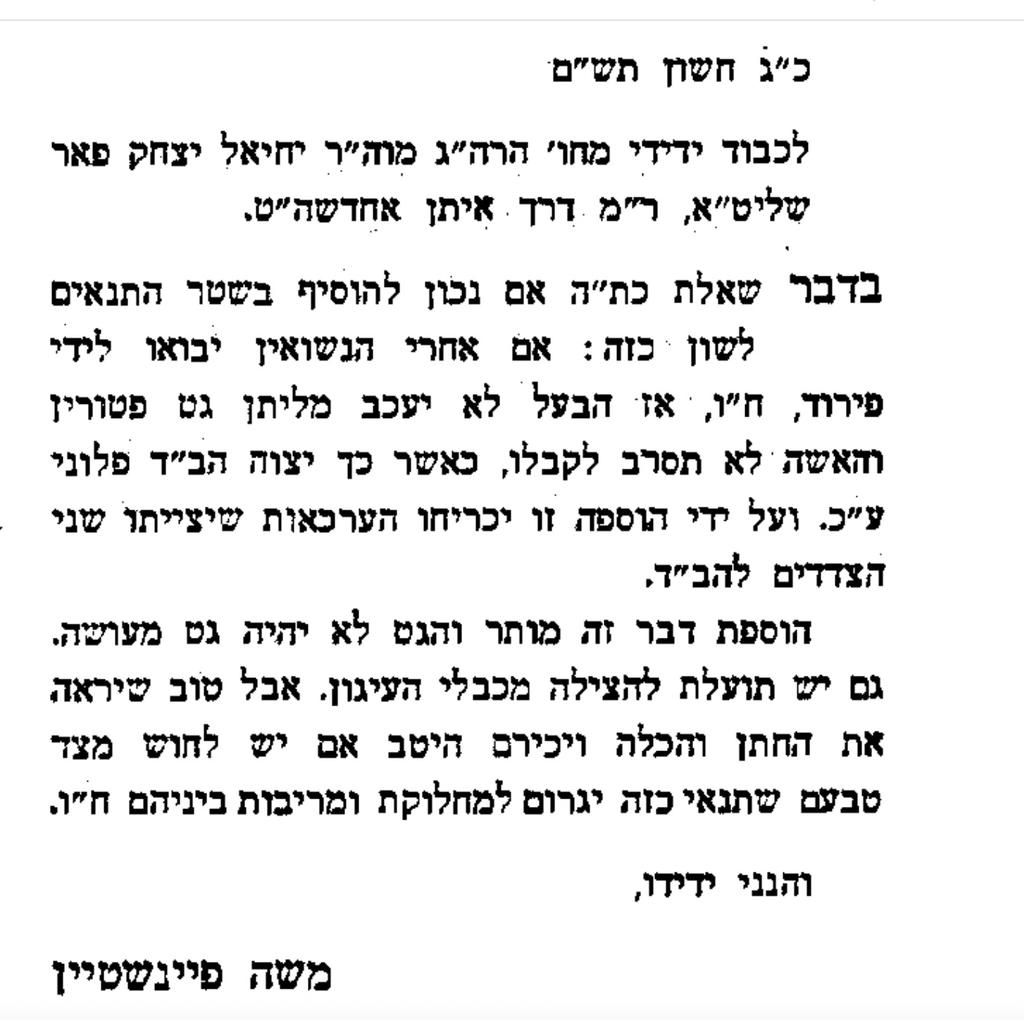
“To my dear friend Rav Yechezkal Abramsky, shlita, the av beis din of
Slutzk:
“I have received the get from the city of Houston in America on behalf
of an agunah here [in Rav Moshe Feinstein’s town of Luban]. This get
has many problems…”
After seeking and finding an allowance for this questionable get, Rav
Moshe concludes:
“Nevertheless, there is still what to investigate, as it is clear that this rav
is not proficient in these halachos…I am sending this rav (in Houston) a
basic primer on hilchos gittin, for I fear that perhaps some/many other
American rabbanim do not know the halachos of correct gittin…Your
dear friend, Moshe Feinstein”
(shu”t Igros Moshe, ev”h, 1:142)
Rav Moshe then shared with Rav Abramsky a sharp letter he - Rav
Moshe – composed and sent to this rabbi in Houston (ibid. 143):
“ To Harav…of Houston, Texas, shlita
“I received the get, yet I have yet to deliver it for [quoting from mishlei,
24:31] ‘thistles had grown all over it; nettles had covered its face’
regarding matters where one should be more careful…but for an agunah
we may perhaps allow it bdieved…I will judge you lkaf zechus, excused
due to not having a proficient sofer nearby, and perhaps there are other
reasons…but I’m confused in that you honor yourself as a ‘baki’
(proficient) in gittin’ yet still asked that I send you a primer of its basic
laws and then treat it as a joke, clearly [from the get Rav Moshe later
received] not even looking at it…”
Rav Moshe then methodically shares with this rabbi each of the many
halachic concerns with this get, including how even some of the names
in the get were spelled incorrectly.
Rav Moshe concludes the printed teshuva with a rare afterward:
“After waiting a long time -until adar of 5689/1929 -and never receiving
[anything from this rabbi], because she is an agunah, I relied on what I
wrote [to Rav Abramsky]…and she may now marry…may Hashem aid
me in never stumbling, heaven forfend, in a matter of halacha, ever”
A noted posek shared with me a fascinating postscript to the above.
Rav Nota Greenblatt, himself a talmud muvhak of Rav Moshe, told this
posek that this Houston rav “Iz nit gevein ah katil kanya (see Shabbos
95a); eir iz geven ah gantz feiner Talmud chacham -he was no
simpleton, but a real talmud chacham”.
Issues with gittin and local rabbanim can still arise. In 2008, I
composed the following invitation to all Young Israel rabbanim:
“Rabbanim Chashuvim,
“It is a seminal moment for a young rav when HaRav Nota
Greenblatt is called upon to assist in a get…having a competent posek
on ‘standby’ -willing to fly out at a moment’s notice - is an invaluable
resource...one small error on our part can, for example, create a get
me’usah, R”l.
“…We have arranged a ‘shiur klali’ on the topic of ‘Gittin
L’Maaseh’ to be delivered by Rav Greenblatt, and open only to
rabbannim…primarily focusing on matters critical for the ‘local rav’.
This is an exceptional opportunity…”
Aside for the obvious, the patient reader will be rewarded with a
deeper connection the above -and what follows - has with the history
of our early rabbanim.
In gittin, exactitude and meticulousness are indispensable; an error
of omission or commission in any number of details can void the divorce
contract in its entirety, possibly leading to the sullying of kedushas
Yisroel, R”l.
Simply determining the name(s) and spelling(s) can be mystifying
to even the most erudite masmid.
For instance, does ‘Monsey’ derive from the Munsee Indians
(thereby necessitating an aleph)? Why is Muncie, Indiana spelled
differently? (For the full story behind Monsey’s first get, The Jewish
Observer, kislev 1976, by Rav Aryeh Kaplan, ‘A Get In Monsey’, p. 15-
19)
Related confusion was found in Brisk, which was known by three
different names! (On Brisk, see Pischei Teshuva, even haezer, siman,
128:31)
It is astonishing to consider that even the uncommon expertise of
‘historical etymology’ becomes indispensable in writing gittin – ‘hufuch
buh’, indeed!
I will share two examples, which will both show its complexity and
serve the reader in understanding the connection these halachos have
with our history.
A get will include both a city’s name and the name(s) of its water
sources (see shu”t HaRan 42 with Shulchan Aruch, ibid.; cf. shu”t
HaRosh 45;21). Not only does this remove the concern of confusing a
get with that of another other city of the same name, but also because of
consistency, as water sources will often maintain their original
designations, even if/when its nearby city changes its name in the future.
- Queens and Brooklyn include the phrase ‘…al nehar east
river…’EDITOR-keep ellipses, as more waters are named before
and after. While this seems redundant - as ‘nehar’ already means
river or lake, thus translating to ‘East River river’ -Rav Moshe
Feinstein asserts that ‘east’ is not seen as a descriptive alone, but
part of its title (Igros Moshe, even haezer 4:101, end).
- What about Houston, Texas -the city Rav Moshe mentioned
above, in 1928? On the one hand, its pronounced youston, so yud,
vav, samech, tes, nun would be its get spelling. On the other hand,
on the Lower East Side is the famed ‘Houston Street’, which is
pronounced howston! This shift in pronunciation derives from
their two distinct origins. The street is named for one of
America’s founding fathers, George Houston (d. 1813), who
indeed pronounced it howston. The southern city is named for the
Texas revolutionary general Sam Houston (d. 1863), who
pronounced it youston!
While we spell it in a get ‘youston’ (yud, vav, samech…), in Rav
Moshe’s first teshuva above he first spells it ‘howston’ (hei, vav,
yud…), switching in a later teshuva to the way we spell it today.
In the sefer Ha’aretz L’Areha, the posek and get expert Rav
Menachem Mendel Senderovic, shlita, shares a 1963 get from
Houston still spelling it ‘howston’, although he agrees with the
‘you’ spelling utilized today (p. 36, s.v. ‘houston’).
All of the above should make the point that to discover who the early
talmidei chachamim were in any given city, one can start by discovering
said city’s earliest get. Indeed, this sefer is one of my ‘go-to’ references
for this summer series.
In Buffalo -the city we have spent this summer discussing - some of
the earliest gittin were written by Rav Dov Ber Zuckerman (see ibid. p.
9, s.v. ‘buffalo’).
Who was this gaon? And who were the others that served this city
after the passing of the already discussed rebbe, Rav Rabinovitch, and
Vilna’s Rav Franklin?
The reader may be surprised…
To be continued next week, iy”H.
(רנה) כלל גדול יש בהתרות עגונות: שכל מקום שאין הענין פשוט להיתר כל כך וצריך שאלת חכם, אפילו היותר גדול בתורה לא יתיר בעצמו עד שיסכימו עוד עמו שני גדולי ישראל, וכך נהגו כל גדולי עולם מעולם כמו שמבואר בכל התשובות, וגם הנשאת ע"פ עד אחד מושיבין ב"ד של שלשה ומתירין אותה כמ"ש בסעי' קי"ז ע"ש, ואין לשנות.
Throughout the centuries other ideas have been introduced to solve various agunah concerns, such as Rav Singer of Galicia’s method for soldiers pre-World War 1. Although this method found prominent support, it offers no advantage in a modern setting for reasons too broad to go into here (see Rav Singer’s great nephew’s Grey Matter [Rav Jachter] for further discussion of this method. See also Igros Moshe ibid. 111).
Other methods have been proposed by such luminaires as Rav Henkin zt’l, but were unfeasible, often dubious and were ultimately retracted (see also Rav Ahron Kotler, Mishnas Rav Ahron 60).
In the 1920’s a sefer was composed titled ‘Ein Tnai B’kidushin’ which came to oppose directly the many innovative ideas that were being introduced at the time. This sefer comes with a haskama and a halachic history lesson by Rav Chaim Ozer zt’l.
These names and histories are important because the relatively modern prenuptial agreement comes to assuage many of the known prior concerns.
The chief novelty of the modern prenup is simple (what follows is not meant as an exhaustive review):
To take advantage of the husband’s halachic obligation to support his wife.
Why not put that in writing, either before (prenup) or after (postnup) marriage stating that, should it, chalila, come to such a point, they will settle their divorce through the arbitration of a reputable beis din? But more: The chosson would further agree that should the marriage dissolve to the point that his wife lives away from him –or he from her- then he should pay her $X per day (about $150 changing for inflation and customary needs) in living expenses [an anyway existing obligation of mezonos or extra mezanos] until such time that a get is delivered.
This would greatly dissuade a husband from withholding or preventing a get, and should secular courts honor such agreements (and it seems as if they would) this would leave him few places to hide.
The geonim, such as Rav Willig, who helped compose this prenup reached out to prominent poskim in Eretz Yisroel, such as Rav Ovodia Yoseph and Rav Asher Zelig Weiss, who either verbally or in writing supported this new idea.
While we will name below the many geonim who outright support this prenup, it is important to point out that some supporters’ positions on this matter is not as black and white as it may first seem.
Rav Asher Zelig Weiss, for instance, certainly does not agree with the composers shlita on every point. Most extraordinary is his point of departure on the knas/fine itself. He points out in his public letter of support that the wife will not in reality have an automatic claim on this money (due to homotzi meichaveiro aluv haraya – as the husband could say ‘kim li’ [a halachic tool beyond the scope of this short monograph])! While he agrees that there is no halachic concern with the prenup, he raises this (and other) weaknesses in the power this arrangement will serve, as well as challenging its historical precedent, most critically that contra Rav Willig, the Nachalas Shiva’s form can not serve as precedent to the modern prenup.
Rav Zalman Nechemia Goldberg is also quoted as supporting this prenup, and is listed as such on the RCA’s prenup website.
However, some have pointed out (see ‘Communications’, Tradition 44:1) that he may have retracted or clarified his position. The idea that the husband obligates himself to waive certain rights and to also finically support his wife daily may only be done, he says, if there is no other ulterior motive involved; it must be done simply so as to attend to his wife’s needs (for reasons made clear below).
In addition, some of the rabbanim who have been quoted in certain non-rabbinic venues and blogs as newly or for the first time publicly supporting the prenup have a far more nuanced position than as described. Some are listed as supporters simply based on the fact that they are known to support people or organizations that themselves support this new prenup. While these poskim may perhaps also support this modern prenup, such chad gadya’s are not the way of discovery on the matter.
One prominent posek named in one such article as a supporter told me over the phone that he would not urge its use (for reasons beyond the scope of this article) and he only said that such a prenup does not invalidate the get.
This is an important leniency in and of itself. A common misconception among the laity is that we can force a husband to write a get. In fact, a get meusah/a forced get is invalid in most instances, to the point that before a husband gives a get the mesader get will ask him if there is anything obligating him to give it!
The Rashba writes in a teshuvah that should a husband even except upon himself a knas (fine) should he not give a get (e.g. “If I don’t give a get in 10 days then I will give $100,000 to Ploni”) such a get would be deemed a get meusa (a forced get) and be pasul. The Rama (siman 134) paskens that we should be machmir like the Rashba.
Some, then, may argue that the modern prenuptial agreement, where the husband sets a fine for each day that he does not give a get, would be precisely what the Rashba ruled is forbidden!
However, one could retort (as does Rav Asher Zelig Weiss, and this other prominent posek with whom I spoke) that this prenuptial agreement does not tie his obligational payment to giving or not giving the get, rather the giving of a get would stop current payment, a payment which anyway his kesubah obligates him to.
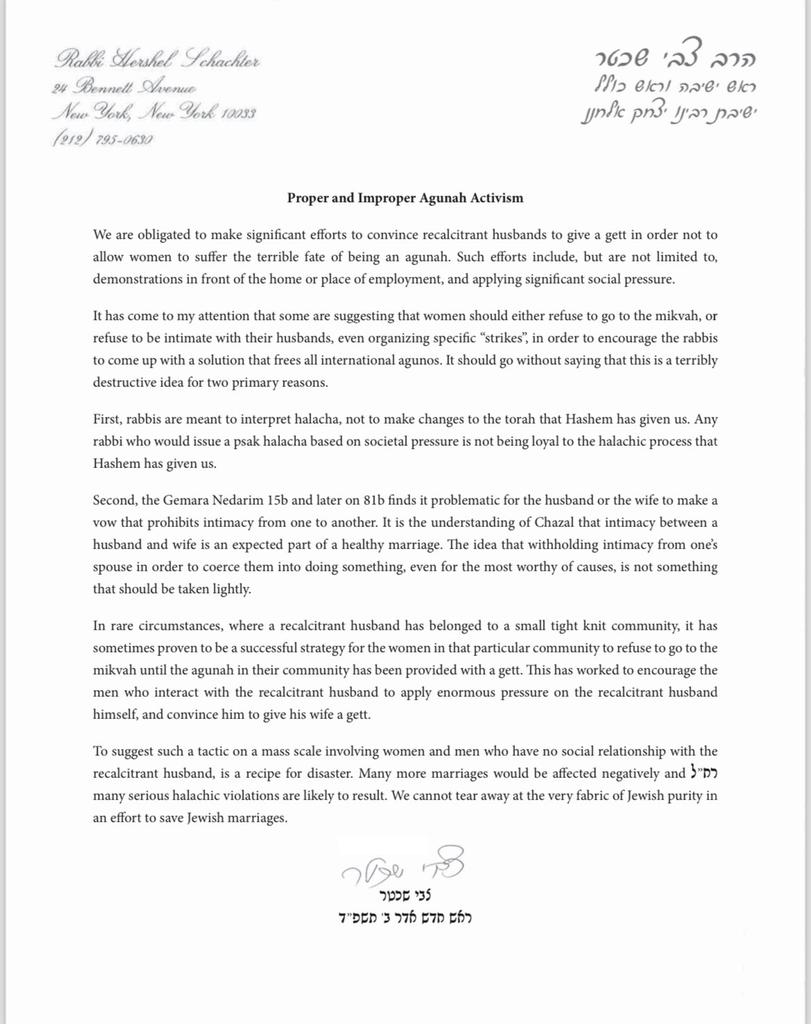
While there are certainly prominent poskim who support this prenup, such as Rav Ovadia Yosef (although some contest the strength of this endorsement– see R. Shalom C. Spira, 5th edition, A:26) Rav Chaim Zimbalist, Rav Reiss, Rav Shachter and Rav Willig and many others, there are many who are parve or opposed to it.
Rav Aviner, one of the leading daati leumi poskim in Israel opposes the prenup and quotes Rav Shternbuch of the eidah hachareidis as saying that it could lead to what would be tantamount to a coerced get.
Regarding Rav Elyashiv’s view, it gets a little interesting. One of the central debates surrounding the prenup is the issue of asmachta –a commitment that is dependent on other factors and toward which the agree-er does not really expect to happen. A groom signing this document on his happiest day likely can’t truly and honestly imagine getting into a disagreement with his new bride let alone divorcing her! Therefore, perhaps, anything he agrees to in a prenup is voided!
While many debate this issue back and forth, Rav Willig proves from a teshuvah of Rav Elyahsiv (1:163) that this type of asmachta would be of no concern. However elsewhere, ironically, it is Rav Elyahsiv himself -in a latter teshuva in his next volume - who seems to disallow the entire enterprise of such prenups to begin with!
I recall several years ago there was a meeting with several kashrus organizations. At the time there was an issue relating to kashrus that had kosher world in a dither. There was much ambiguousness among the Jewish world as to what the right thing to do was and whether ‘this’ was allowed or not, as the rabbanim too were divided and, some, unclear on the matter.
Rav Shmuel Kamanetzky rose to speak and after giving his view on the matter at hand he suggested that perhaps in the future before announcing a concern to the public we should first wait for clarity.
While every posek and organization that works with poskim has an obligation to share their view (see hakdama to Igros Moshe), it would be wise for citizen journalists, well intentioned as they may be, not to confuse the masses with tales of consensus before there is any.
On this matter of prenups, boruch Hashem, all parties involved are talmidei chachamim par excellence and lshem shomayim, and consensus, should it come at all, will take time.
In the meantime, each of us should simply follow our own rebbeim on the matter.
Let us hope that our respect for the halachik process will be a zechus toward the agunos of today and help prevent any agunah of tomorrow.
מתני׳ האשה שהלך בעלה למדינת הים ובאו ואמרו לה מת בעליך וניסת ואח"כ בא בעלה תצא מזה ומזה וצריכה גט מזה ומזה ואין לה כתובה ולא פירות ולא מזונות ולא בלאות לא על זה ולא על זה ואם נטלה מזה ומזה תחזיר והולד ממזר מזה ומזה ולא זה וזה מטמא לה ולא זה וזה זכאים לא במציאתה ולא במעשה ידיה ולא בהפרת נדריה היתה בת ישראל נפסלה מן הכהונה ובת לוי מן המעשר ובת כהן מן התרומה ואין יורשין של זה ויורשין של זה יורשין את כתובתה ואם מתו אחיו של זה ואחיו של זה חולצין ולא מייבמין ר' יוסי אומר כתובתה על נכסי בעלה הראשון רבי אלעזר אומר הראשון זכאי במציאתה ובמעשה ידיה ובהפרת נדריה רבי שמעון אומר ביאתה או חליצתה מאחיו של ראשון פוטרת צרתה ואין הולד ממנו ממזר ואם ניסת שלא ברשות מותרת לחזור לו ניסת על פי ב"ד תצא ופטורה מן הקרבן לא ניסת על פי ב"ד תצא וחייבת בקרבן יפה כח ב"ד שפוטרה מן הקרבן הורוה ב"ד לינשא והלכה וקלקלה חייבת בקרבן שלא התירוה אלא לינשא: גמ׳ מדקתני סיפא נשאת שלא ברשות מותרת לחזור לו שלא ברשות ב"ד אלא בעדים מכלל דרישא ברשות ב"ד ובעד אחד אלמא עד אחד נאמן ותנן נמי הוחזקו להיות משיאין עד מפי עד ואשה מפי אשה ואשה מפי עבד ומפי שפחה אלמא עד אחד מהימן ותנן נמי עד אחד אומר אכלת חלב והוא אומר לא אכלתי פטור טעמא דאמר לא אכלתי הא אישתיק מהימן אלמא עד אחד מהימן מדאורייתא מנא לן דתניא (ויקרא ד, כג) או הודע אליו חטאתו ולא שיודיעוהו אחרים יכול אע"פ שאינו מכחישו יהא פטור תלמוד לומר או הודע אליו מ"מ היכי דמי אילימא דאתו תרי ולא קא מכחיש להו קרא למה לי אלא לאו חד וכי לא קא מכחיש ליה מהימן ש"מ עד אחד נאמן וממאי דמשום דמהימן דלמא משום דקא שתיק ושתיקה כהודאה דמיא תדע דקתני סיפא אמרו שנים אכלת חלב והוא אומר לא אכלתי פטור רבי מאיר מחייב אמר ר' מאיר קל וחומר אם הביאוהו שנים לידי מיתה חמורה לא יביאוהו לידי קרבן הקל אמרו לו מה אם ירצה לומר מזיד הייתי רישא...
........משום עיגונא אקילו בה רבנן:
...The Gemara answers: Due to the case of a deserted wife, the Sages were lenient with her. Since it is not always easy to find two witnesses to attest to a husband’s death, the Sages realized that if the testimony of one witness were not accepted, the woman would be likely to remain a deserted wife, unable to remarry. However, to prevent this leniency from causing mistakes and licentiousness, they were very stringent with her in a case where the testimony is found to be erroneous, to ensure that she is very careful not to accept untrustworthy accounts
... אין כל דמקדש אדעתא דרבנן מקדש ואפקעינהו רבנן לקדושין מיניה
.... Both Rabba and Rava agree that by Torah law the bill of divorce is nullified once the husband is healed from his illness, yet they treat the bill of divorce as valid. How can this be? The Gemara answers: Yes, the Sages have the ability to nullify even a marriage that took effect by Torah law, because anyone who betroths a woman betroths her contingent upon the will of the Sages, and when one fails to conform to their will in matters of marriage and divorce the Sages expropriated his betrothal from him retroactively. Consequently, it is permitted for the woman to remarry.
(נז) אע"פ כו'. ר"ל יש לדמות למ"ש ביבמות צ' ב' וש"מ דמאן דמקדש כו' ואפקעינהו כו' ושם ק"י א' הוא עשה כו' וערש"י שם ושם מ"מ צ"ע למעשה עתוס' ד"ה לפיכך כו':
(כא) הגה קהל שתקנו ועשו הסכמה ביניהם שכל מי שיקדש בלא עשרה או כיוצא בזה ועבר אחד וקידש חיישינן לקידושין וצריכה גט אע"פ שהקהל התנו בפירוש שלא יהיו קדושין והפקירו ממונו אפ"ה יש להחמיר לענין מעשה


אמר רבי אמי דברים שבינו לבינה נאמנת וטעמא מאי היא קיימא לה ביורה כחץ הוא לא קים ליה ביורה כחץ אמר איהו איזיל אינסיב איתתא ואיבדוק נפשאי אמר רבי אמי אף בזו יוציא ויתן כתובה שאני אומר כל הנושא אשה על אשתו יוציא ויתן כתובה
(ט) נושא אדם כמה נשים והוא דאפשר למיקם בסיפוקייהו ומ"מ נתנו חכמים עצה טובה שלא ישא אדם יותר מד' נשים כדי שיגיע לכל אחת עונה בחודש ובמקום שנהגו שלא לישא אלא אשה א' אינו רשאי לישא אשה אחרת על אשתו: (וע"ל ס"ס ב' דאסור לישא שני נשים בשני מקומות)
(9) A man may marry a number of women provided that he has the means to sustain them, and what we find is that the sages gave worthy suggestion that a man marry no more than four women so that he may fulfill his obligation once a month. In a place where they are accustomed to only marry one woman they are not permitted to marry another woman. Note: it is forbidden to marry two women in two places.
With regard to the dead, the Sages equated the legal status of
the second Festival day with that of a weekday

(י) נפלים שנהגו להסיר ערלתן בצרור אבן או בקנה אסור אפילו ביום טוב שני של גליות: הגה ואסור לקברו ביום טוב אלא מניחו עד למחר: (ב"י)
(10) 10. Those who have the practice to remove fetuses' foreskin with a rock or reed are prohibited from doing so even on the second day of a holiday. Rem"a: It is prohibited to bury it that day. Rather, we wait until tomorrow (Beit Yosef).


Rabbi Moshe Taub
Killing the Enemy
Ethics of War
(Part 3)
When peace comes, we will perhaps in time be able to forgive the Arabs for killing our sons, but it will be harder for us to forgive them for having forced us to kill their sons. – Golda Meir
The questions of the ethics of war may seem oxymoronic. Isn’t the purpose of war to kill people and destroy things?
However, halachah is replete with guidelines for ethical conduct in war, to the point of warning us not to cut down fruit trees in the heat of battle. Indeed, after the Iraq invasion of 2003, the American administration was reproached for not defending landmarks and artifacts more carefully. It would seem that as Jews, we should relate to such a charge.
Recently The Jerusalem Post covered issues of halachah and war, in particular the treatment of captured killers and terrorists. While there are many issues that fall under this rubric, we will focus here on the issue of whether a subdued terrorist may be killed. What follows is a discussion of Talmudic law and not of practice.
From the article:
“Several senior rabbis have raised a heated debate in the last few days over the approach in Jewish law toward a terrorist who has committed a terror attack but is subsequently wounded and incapacitated. …
“Rabbi David Stav said that the nation was facing trying and difficult times but insisted that a terrorist who has committed an attack but has been wounded and therefore no longer represents a threat should not be further harmed.
“‘In these days in which the blood is boiling...it is important to preserve our moral superiority: [We must] not harm those who are not involved in murderous acts, and we must not harm those who have already been neutralized and do not represent a threat,’ the rabbi ruled.
“Rabbi Shmuel Eliyahu, municipal chief rabbi of Safed, reacted to Stav’s comments and said a terrorist who had committed murder should himself be killed.
“’It is forbidden to leave a murderer alive,’ Eliyahu told the Galei Yisrael radio station on Wednesday. He accused Tzohar rabbis of ‘forgetting Jewish law’ and said ‘they are only interested in looking good to non-Jews.’”
This is a most serious issue, one best left to our greatest poskim and those who live in Eretz Yisrael. Following is a review of some of the factors involved in making such a decision.
First, Rav Moshe Feinstein, zt”l, recognized that not all cases are equal when it comes to imposing the death penalty for a criminal act. In a famous teshuvah to the governor of New York,1 he outlined how halachah views the death penalty. Rav Moshe sought to dissuade the governor from using the death penalty, explaining that one of the reasons the Torah prescribes it is to impress upon us the egregiousness of certain acts and that the halachic bar is set too high to allow regular use of such punishment.
Nevertheless, he ends with the following message: “The above is true regarding crimes of passion…but if people are killing because of cruelty and because the lives of others are meaningless to them…or if there appear to be many murderers,” a country must do what is in its best interest.
It would seem that a country that is under constant attack and is therefore in a perpetual state of war has every right at least to consider whether such terrorists deserve to be put to death by the state.
Noncombatants
The Ramban and Rambam famously debate the general question of war as it pertains to ostensibly innocent civilians. The debate, which is based on Shimon and Levi’s battle over their sister Dina’s abduction, is germane to the question of captured terrorists.
The Ramban believed that Shimon and Levi’s decision to kill all the males of Shechem was an error, one for which Yaakov reprimanded them. After all, why should the city’s ordinary citizens have been held accountable for the action of their leaders? How could they have stopped it?
Rambam, however, believes that the citizens were not powerless; in fact, they had failed to fulfill the universal obligation to establish justice systems. Because setting up courts is one of the seven Noachide laws, those who fail to do so are equally liable to death.
In Gur Aryeh, the Maharal seeks to combine these two views. He suggests that although, on one hand, the civilians of Shechem cannot be held responsible, the rules in a time of war are different. A nation must respond to threat with force so as to end present and future danger, and this means that civilians may be affected. While this position is not an argument for the capricious killing of civilians, the Maharal does seem to support strategic strikes even if noncombatants will be harmed.
A quick look at modern warfare would support a silent secular agreement with the Maharal’s view. From the United States’ recent bombing of a hospital (purported to be an accident) to the more than 100,000 victims of the bombings of Hiroshima and Nagasaki, which brought World War II to an end, it seems that world powers are resigned to such carnage when it is absolutely necessary.
In the case of a captured terrorist, therefore, it seems there may be support for a country under attack to carry out unceremonious executions of captured killers, since this is a means of deterring the enemy.
Rodef
Even when in a situation involving two Jews, the Torah makes it very clear that one is allowed to kill a pursuer (rodef) in self-defense. We should also point out parenthetically that the Bach and the Shach discuss the issur of retzichah and whether it is suspended during a time of war for the zayin amim.2
Although a terrorist is clearly a rodef, a halachic pursuer whom we are permitted to kill, we can only do so if there is no other way of stopping him. As Chazal point out, if one can stop a pursuer by shooting him in a limb, for example, that is all that would be allowed. Someone in captivity is already immobilized, so what allowance would there be to kill him based on the principle of rodef?
One may argue that a subdued terrorist should be seen as a passive pursuer. This means there are times when the mere presence of an innocent person is dangerous3—for example, a case where a baby’s crying will alert the enemy to one’s presence, or when the enemy orders a community to hand over an innocent person on the threat that they will all be killed otherwise. In such a case, halachah will sometimes view the innocent person as a rodef.4
Based on this idea of a “passive rodef,” perhaps one can argue that the fact that we choose to keep enemy prisoners alive and in relatively good health during a time of war only emboldens the enemy to continue killing us. Astonishingly, the average weight gain among al-Qaeda detainees in American hands is about twenty pounds!5
However, all of this is academic as many poskim contend that the halachah of dina d’malchusa (adhering to modern secular law) outweighs the halachos of redifah. This means that even if a cogent halachic argument can be made for putting to death a captured killer, there would be little an IDF soldier could do about it legally.
Sofek Rodef: A Possible Future Rodef
The issue of prisoner exchanges is a related—and volatile—issue that we have discussed in the past (see issue 43, “Gilad Shalit: Sundry Matters”). According to those poskim who favor such exchanges, killing the terrorist may mean eliminating a real negotiating tool. This is not to support such an argument, of course, but simply to raise awareness of it.
Indeed, strong disapproval of such exchanges based on the argument that they may result in Jewish deaths may actually be an argument in favor of execution, because it prevents dangerous terrorists from being returned to the street. Yet at most, such an argument would only make the captured terrorist a safek rodef (possible rodef).
Aside from the fact that the principle of dina d’malchusa dina eclipses such arguments, Rav Chaim Ozer and many others6 argue that a possible rodef is not the same as a rodef.
Geneva Conventions
Even if we could resolve all of the dilemmas raised thus far, perhaps the most critical issue is how the state of Israel and halachah should view the rules of war established at the Geneva Convention, as well as various United Nations agreements.
Rav Chaim Jachter, after a lengthy treatment of the issue of killing innocents in wartime, cites the following passage from The Case for Israel by famed professor Allen Dershowitz, in support of the argument that not all international laws, or countries following them, are created equal:
“Although collective punishment is prohibited by international law, it is widely practiced throughout the world, including the most democratic and liberty-minded countries. Indeed, no system of international deterrence can be effective without some reliance on collective punishment. Every time one nation retaliates against another, it collectively punishes citizens of that country. The American and British bombings of German cities punished the residents of those cities. The atomic bombings of Hiroshima and Nagasaki killed thousands of innocent Japanese for the crimes of their leaders. The bombing of military targets inevitably kills civilians.”
In other words while there are certainly agreements like the Geneva Conventions, there seems to be surreptitiously accepted understandings, practices and immunities in a time of war. This is without even addressing the latest United States targeted drone killings, which some argue are questionable according to a strict reading of codified international law.
Chillul Hashem
Above all, we must be mindful of chillul Hashem.
Let us conclude with the words of Rav Yehudah Henkin, grandson of Rav Yosef Eliyahu Henkin, one of the great poskim of the last generation, and the father of Eitam Henkin, who was murdered along with his wife, Naama, during Sukkos in what is now viewed as the beginning of the current wave of attacks.
In his halachic work Bnai Banim7 he focuses on questions similar to the ones we have raised here. He writes that even in war, regardless of what halachah permits, we also must be concerned about chillul Hashem.
He points to Sefer Yehoshua (ch. 9), in which the Givonim fool Bnei Yisrael into entering into an alliance with them and allowing them to remain alive. The Gemara8 wonders why this treaty was not voided as soon as the ruse was discovered. The Gemara answers, “In order to sanctify Hashem’s Name”; Rashi explains that Yehoshua was concerned about the Jewish army’s reputation among the nations if it did not honor its treaties.
It is of interest, I believe, that while the Gemara uses a positive expression (“due to a kiddush Hashem”), the Rambam, in codifying as law the story of the Givonim,9 uses the negative (“due to a chillul Hashem”). The indication is that even during a war, when defending ourselves is a top priority, we must find ways to prevent a chillul Hashem—as well as going out of our way (if it won’t put lives at risk) to create an active kiddush Hashem.
May we achieve both of these ideals, maintaining our achdus as we debate these serious matters. And may these attacks end quickly, leaving all such questions academic in nature as we herald Moshiach Tzidkeinu.
NOTES
1. Igros Moshe Choshen Mishpat 2:68.
2. See Shulchan Aruch Yoreh Deah, siman 158:1. Regarding the application of this concept today, see, for example, Rambam Hilchos Melachim 5:4, and Tashbeitz 93.
3. See Rama Yoreh Deah 157:1 et al.
4. See note 20 in Rabbi Bleich’s “Torture and the Ticking Time Bomb” for further details on this type of rodef.
5. USA Today, 10/3/06. See also the thorough study conducted by Seton Hall’s Center for Research and Development, which reports that 50.67% of the detainees housed there are overweight!
6. See the strong words of Rav Moshe in Choshen Mishpat 2:69:4.
7. Vol. 3, maamar 4, page 4, 185-194.
8. Gittin 46.
9. Hilchos Melachim 6:5.
תניא רשב"י אומר העובד עבודת כוכבים ניתן להצילו בנפשו מק"ו ומה פגם הדיוט ניתן להצילו בנפשו פגם גבוה לא כל שכן וכי עונשין מן הדין קא סבר עונשין מן הדין תניא רבי אלעזר ברבי שמעון אומר המחלל את השבת ניתן להצילו בנפשו סבר לה כאבוה דאמר עונשין מן הדין ואתיא שבת בחילול חילול מעבודת כוכבים א"ר יוחנן משום ר"ש בן יהוצדק נימנו וגמרו בעליית בית נתזה בלוד כל עבירות שבתורה אם אומרין לאדם עבור ואל תהרג יעבור ואל יהרג חוץ מעבודת כוכבים וגילוי עריות ושפיכות דמים ועבודת כוכבים לא והא תניא א"ר ישמעאל מנין שאם אמרו לו לאדם עבוד עבודת כוכבים ואל תהרג מנין שיעבוד ואל יהרג ת"ל (ויקרא יח, ה) וחי בהם ולא שימות בהם יכול אפילו בפרהסיא תלמוד לומר (ויקרא כב, לב) ולא תחללו את שם קדשי ונקדשתי אינהו דאמור כר"א דתניא ר"א אומר (דברים ו, ה) ואהבת את ה' אלהיך בכל לבבך ובכל נפשך ובכל מאדך אם נאמר בכל נפשך למה נאמר בכל מאדך ואם נאמר בכל מאדך למה נאמר בכל נפשך אם יש לך אדם שגופו חביב עליו מממונו לכך נאמר בכל נפשך ואם יש לך אדם שממונו חביב עליו מגופו לכך נאמר בכל מאדך גילוי עריות ושפיכות דמים כדרבי דתניא רבי אומר (דברים כב, כו) כי כאשר יקום איש על רעהו ורצחו נפש כן הדבר הזה וכי מה למדנו מרוצח מעתה הרי זה בא ללמד ונמצא למד מקיש רוצח לנערה המאורסה מה נערה המאורסה ניתן להצילו בנפשו אף רוצח ניתן להצילו בנפשו ומקיש נערה המאורסה לרוצח מה רוצח יהרג ואל יעבור אף נערה המאורסה תהרג ואל תעבור רוצח גופיה מנא לן סברא הוא דההוא דאתא לקמיה דרבה ואמר ליה אמר לי מרי דוראי זיל קטליה לפלניא ואי לא קטלינא לך אמר ליה לקטלוך ולא תיקטול מי יימר דדמא דידך סומק טפי דילמא דמא דהוא גברא סומק טפי כי אתא רב דימי א"ר יוחנן לא שנו אלא שלא בשעת גזרת המלכות) אבל בשעת גזרת המלכות אפי' מצוה קלה יהרג ואל יעבור כי אתא רבין א"ר יוחנן אפי' שלא בשעת גזרת מלכות לא אמרו אלא בצינעא אבל בפרהסיא אפי' מצוה קלה יהרג ואל יעבור מאי מצוה קלה אמר רבא בר רב יצחק אמר רבאפילו לשנויי ערקתא דמסאנא וכמה פרהסיא אמר ר' יעקב אמר רבי יוחנן אין פרהסיא פחותה מעשרה בני אדם פשיטא ישראלים בעינן דכתיב (ויקרא כב, לב) ונקדשתי בתוך בני ישראל בעי רבי ירמיה תשעה ישראל ונכרי אחד מהו תא שמע דתני רב ינאי אחוה דרבי חייא בר אבא אתיא תוך תוך כתיב הכא ונקדשתי בתוך בני ישראל וכתיב התם (במדבר טז, כא) הבדלו מתוך העדה הזאת מה להלן עשרה וכולהו ישראל אף כאן עשרה וכולהו ישראל והא אסתר פרהסיא הואי אמר אביי אסתר קרקע עולם היתה רבא אמר הנאת עצמן שאני דאי לא תימא הכי הני קוואקי ודימוניקי היכי יהבינן לה אלא הנאת עצמן שאני הכא נמי הנאת עצמן שאני ואזדא רבא לטעמיה דאמר רבא עכו"ם דאמר ליה להאי ישראל קטול אספסתא בשבתא ושדי לחיותא ואי לא קטילנא לך ליקטיל ולא לקטליה שדי לנהרא ליקטליה ולא ליקטול מ"ט לעבורי מילתא קא בעי בעו מיניה מר' אמי בן נח מצווה על קדושת השם או אין מצווה על קדושת השם אמר אביי ת"ש שבע מצות נצטוו בני נח ואם איתא תמני הויין א"ל רבא אינהו וכל אבזרייהו מאי הוי עלה אמר רב אדא בר אהבה אמרי בי רב כתיב (מלכים ב ה, יח) לדבר הזה יסלח ה' לעבדך בבא אדני בית רמון להשתחות שמה והוא נשען על ידי והשתחויתי וכתיב (מלכים ב ה, יט) ויאמר לו לך לשלוםואם איתא לא לימא ליה הא בצנעה הא בפרהסיא אמר רב יהודה אמר רב מעשה באדם אחד שנתן עיניו באשה אחת והעלה לבו טינא ובאו ושאלו לרופאים ואמרו אין לו תקנה עד שתבעל אמרו חכמים ימות ואל תבעל לו תעמוד לפניו ערומה ימות ואל תעמוד לפניו ערומה תספר עמו מאחורי הגדר ימות ולא תספר עמו מאחורי הגדר פליגי בה ר' יעקב בר אידי ור' שמואל בר נחמני חד אמר אשת איש היתה וחד אמר פנויה היתה בשלמא למאן דאמר אשת איש היתה שפיר אלא למ"ד פנויה היתה מאי כולי האי רב פפא אמר משום פגם משפחה רב אחא בריה דרב איקא אמר כדי שלא יהו בנות ישראל פרוצות בעריות ולינסבה מינסב לא מייתבה דעתיה כדר' יצחק דא"ר יצחק מיום שחרב בית המקדש ניטלה טעם ביאה וניתנה לעוברי עבירה שנאמר (משלי ט, יז) מים גנובים ימתקו ולחם סתרים ינעם: