Parashat Tazriah
Friday April 16, 2021
From Likutei Torah by Rabbi Shneur Zalman of Liadi
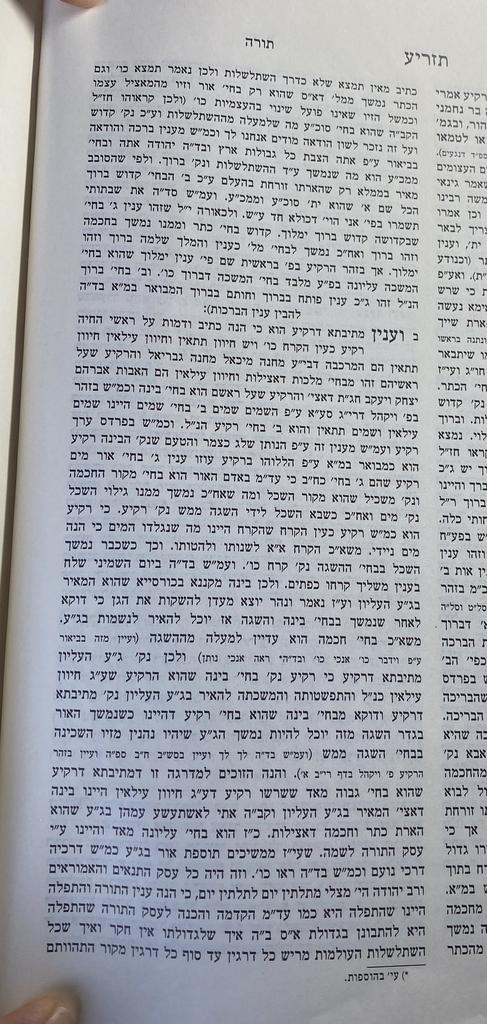
Text begins on page כב column 2 last paragraph
Translation and Commentary by Rabbi Gedalia Potash and William Schecter, MD
This draft has been neither edited nor approved by Rabbi Potash
In the Gemorrah of Baba Metzia in the Chapter Hapoalim (the Workers) there is a disagreement in the Heavenly Yeshiva1: If the Baheret (mole—skin lesion) precedes the appearance of white hair (that is the hair in the lesion subsequently changed from black to white) it is impure and if the hair was white prior to the baheret (mole) it is pure. But the issue is in doubt. G-d said it is pure but all the rabbis in the Heavenly Yeshiva said that it is impure. Here we see a debate between G-d and the Rabbis! Who was present for this debate? Rabbi Bar Nachmani was present and said I am the expert on infections (Biblical Leprosy-not modern medical leprosy—a skin lesion in man as a result of spiritual transgressions—the main one being HaLashon HaRa {negative gossip}. Biblical Leprosy can also affect clothing and the structure of a house or a tent). And I am the expert on Tents (dwellings). And the Gemorrah of Masechect Nazir (65:b) explains that the reason that to declare it (the lesion) pure is the fact that when the passage opens, the word pure appears first.
And we have to understand the issue of the Tanaim (the Rabbis of the Mishnayot who lived from approximately 250 BCE to 250 CE) and the Amoraim (the Rabbis of the Gemorrah who lived after approximatley (250 CE). We see the amazing wonders that these Rabbis could perform. For example, the Talmud tells the story of Rabbi Pinchas Ben Yair who was on his way to ransom prisoners, or some say to give a lecture to students, when he came across the impassable Ginai River. He called upon the waters of the river to separate, which they did, and he was able to cross and reach his destination, similar to the crossing of the Reed Sea by Moses and 600,000 Children of Israel. And even the less accomplished Rabbis were able to revive the dead. All this was accomplished through their engagement in the study of Torah. To explain this, we must first interpret the name with which the Rabbis of the Talmud referred to G-d: “HaKodesh Baruch Hu” (The Holy One Blessed Be He- הקודש ברוך הוא).
Rabbi Potash commented: G-d has many names mentioned in the Written Torah but even though we have all those names, they are not enough. The name HaKodesh Baruch Hu doesn’t appear in the written Torah. The Rabbis of the Oral Torah (the Talmud) used the name HaKodesh Baruch Hu extensively to refer to G-d. Why is this better than the other names in the written Torah? Dr. Philip Lisagor gave an interesting insight. He postulated that there are so many different names for G-d because the Rabbis lived constantly with the awareness of G-d. He compared this with the approximately 30 names that the Eskimos have for snow. Since they live with snow constantly, they are aware to the many different types of snow and their different properties. The Rabbis, Philip postulates, had many different names for G-d describing the innumerable different qualities of G-d that they perceived.
And this explanation comes form the Heavenly Yeshiva. The word Kodesh has the attribute of Keter (Crown). Sometimes the attribute of Tiferet (beauty, one of the 7 emotional Sephirot) in the world of Atzilut is called Kadosh. This is because the attribute of the root of Torah Study is the attribute of Keter. And Keter is called Kadosh (Holy) meaning that it has the attribute of Holiness and is completely separate and above (superior) to the process of Histalshalut (the flowing down in a cascade fashion of the Divine Light through the various Worlds until it reaches our World, the World of Asiyah).
As opposed to Kadosh, the word Baruch has the attribute of Chochma which is the first attribute of the Histalshalut process and the first revelation. What does the Elter Rebbe mean? Kadosh has the attribute of Sovaiv Kol HalOlamim (encircle all the worlds-- סובב כל העולמיםabbreviated as סוכ״ע) whereas Baruch (Blessed – ברוך) has the attribute of Mimaleh Kol HaOlamim (ממלא כל העולמים—filling all the worlds—abbreviated as ממכ״ע). The Rabbis of the Talmud called G-d by the name HaKodesh Boruch Hu (the Holy One Blessed be He) encompassing both concepts of Sovaiv Kol HaOlamim and Mimaleh Kol HaOlamim. The word Baruch has two interpretations. The first, illustrated by King Solomon, who received the Blessing. The second interpretation is that the Blessed One imparts the Blessing and to illustrate this the Elter Rebbe quotes the Song of Songs (4:9) “You have captured my heart, my sister my bride”.
Rabbi Potash commented: The highest of the ten Sephirot Is Chochma (Wisdom). But Keter (Crown) is above all the Sephirot including Chochma. So, what is Keter? There is a higher level associated with Kadosh—the Keter. The Keter is not limited by the Sephirot. The Keter energizes the Sephirot. We translate Kadosh as Holy but it really means “elevatedness” –that is loftiness or exaltation. Keter is called Kadosh (Holy) because it separated from and above the process of Hishtalshut.
“Baruch Hu” Baruch means to draw down or to reveal. The root of the word Baruch means to guide. For example, Ani Mabrich et hagefen (אני מבריך את הגפן—means I guide the grape vine {so that it grows in a certain direction}) Baruch, then, means taking the Divine energy and directing it to a certain person or in a certain direction to connect and reveal what we are trying to achieve. So, Baruch means to draw down and direct to the Sephirah of Chochmah.
In HaKadosh Baruch Hu (the Holy One Blessed be He—one of the names of G-d conferred by the Rabbis of the Talmud) we have Kadosh—above all and Baruch Hu –drawing down—on the one hand G-d is above it all—Sovev Kol Haolamim—and on the other hand he is involved and part of it all—Mimaleh Kol Ha Olamim. This is all brought together by the name HaKodesh Baruch Hu. Sovaiv Kol Ha Olamim means being encircled, supported and having a direct connection. Mimaleh Kol HaOlamim means receiving something almost physical. Rabbi Potash used an analogy. If someone is poor, and you give him money, it is similar to the concept of Mimaleh Kol Haolamim. If you encircle him with love and support, provide him with a job or an education so that he can support himself, and maintain a supportive relationship—that is similar to Sovaiv Kol HaOlamim. Mimahleh Kol HaOlamim is good, but Sovaiv Kol HaOlamim is on a much higher spiritual plane. In fact, we need both.
Our discussion ended at this point on page 44 column 1 approximately mid page with the sentence beginning מקור הברכות שמברך
- The Heavenly Yeshiva (מתיבתא דרקיע) is a Chassidic concept of a Yeshiva to which only the Souls dwelling the supernal Heaven are admitted. Although these Souls study the same Torah as we do, they are only concerned with the purely spiritual concepts.
Continuation of the above translation and commentary on Rabbi Shneur Zalman's commentary on Tazria in Likutei Torah
Translation and Commentary by Rabbi Gedalia Potash and William Schecter MD
April 5, 2022
We take up the discussion from last year. The Elter Rebbe is discussing the meaning of the HaKodesh Baruch Hu which is a way of referring to G-d in the Talmud. Kodesh, says the Elter Rebbe, refers to the Divine attribute of Keter (crown) which is above the 3 intellectual and 7 emotional attributes in Kabbalistic cosmology. It is higher than the process of Hishtalshalut, the flowing down of Divine Energy from the Heavens to our world. Baruch, the second word in the phrase HaKodesh Baruch Hu, has the attribute of wisdom which is the beginning of the Hishtalshalut and revelation. Kodesh has the attribute of Sovaiv Kol HaOlamim (surrounding all the worlds) while Baruch has the attribute of Mimaleh Kol HaOLamim (filling all the worlds) so when the Talmudic Sages coined the term HaKodesh Baruch Hu they were attributing to the divine both attributes: Surrounding and Filling all the worlds.
The word Baruch has two interpretations according to the Elter Rebbe. The first interpretation comes from the expression “And King Solomon is blessed” meaning that he is blessed, that is to say, that he receives the blessing until he becomes blessed.
The second interpretation means Solomon blesses meaning he is the source of the blessings and blesses everything as it is written from this “You have captured my heart my own my bride’ (Song of Songs 4:9).
Comment: I am not clear on how this particular quotation fits in to the Elter Rebbe’s argument.
Our translation now continues beginning on page 44 column 1 mid page with the line beginning with the words ושני הפ׳ אמת כי הנה
And both interpretations are true although Chochma (wisdom) is called Baruch (blessed) as it is written in Pri Etz Haim (A 16TH century Kabbalistic text) that the Foundation Father is called Baruch, in any case sometimes the Malchut is called blessed which is like King Solomon being called blessed.
Comment: What is the Elter Rebbe talking about? Chochma is the highest of the 10 Sefirot (below Keter) and Malchut is the lowest. The Elter Rebbe will go on to say that Malchut receives the blessing flowing down from Chochma. The analogy of King Solomon, one who is blessed and one who blesses is compared to Malchut which receives a blessing from Chochma and in turn passes the blessing down to our world.
He is like the interpretation of the first type of blessing meaning he is blessed and receives the blessing and so the Malchut receives the blessing and the flow from above meaning that the attribute of Chochma (wisdom) is called blessed and the interpretation of the second type is that he is the source of the blessing meaning the letters Baruch are the head and source of every blessing as it is written in Pardes (a Kabbalistic text) about Baruch. Just like a pool from which water flows but the word pool implies that water has already flowed down from above. The attribute of Chochma (wisdom) that is called the source of the pool of Blessing
Comment: Each of the 10 attributes are present in all the worlds including our own. So the Malchut of Atzilut is invested in the Malchut of Briah, etc. down to our world Asiyah.
The process of Hishtalshalut begins with Chochma and then there is a flowing down of energy throught the various attributes to Malchut. But Keter is above the process of Hishtalshalut. It receives its energy directly from the Ein Sof (G-d). Since Histalshalut begins with Chochma, Chochma is the source of the blessing and Malchut can be considered like the pool receiving the blessing from Chochma and then letting it flow down through the process of Histalshalut to the lower worlds.
And it is written in the Zohar He is blessed and she is the blessing. Meaning: She is the Malchut which is called Blessing—She has the attribute of filling all the worlds “Your Kingdom is the kingdom of all the worlds and “He” means the Foundation Father is called blessed because he is the source which influences the attribute of filling all the worlds. Nothing at all can come above the attribute of Chochma (wisdom) with the attribute of filling all the worlds, only encircling all the worlds because it does not come with revelation at all to be the attribute of filling, only encircling. Its shining light is hidden as is known that the internal light and the encircling light cleave one to the other.
Comment: The energies of Makif (surrounding all the worlds) and Mimaleh (filling all the worlds) are on different levels (Makif greater than Mimaleh) but they are connected in Divine Unity
But the encircling light does not shine within the vessel with the attribute of internality and revelation because its light is great and the vessel is unable to contain its light at all although the radiance from the surrounding hidden light shines within the vessel for the surrounding light sparkles half of the vessel from outside as described elsewhere. It is written: the Chochma comes from nil because the Chochma is the beginning of revelation and therefore the attribute of Histalshalut belongs to Chochma. The understanding received from Chochma and Binah flows with attributes by way of cause and effect and therefore Chochma is called blessed. The Chochma comes from the Keter as it is written Chochma is found (comes from) nil and not by way of Hishstalshalut and therefore it is said that Chochma comes from nil. Keter flows from the Malchut of the Infinite One (G-d). This Malchut only has the attribute of Light and the shining ray from the Creator Himself. as by way of example the ray does not make any change in itself etc.
We ended our discussion on page 44, column 2 at the beginning of the second paragraph.