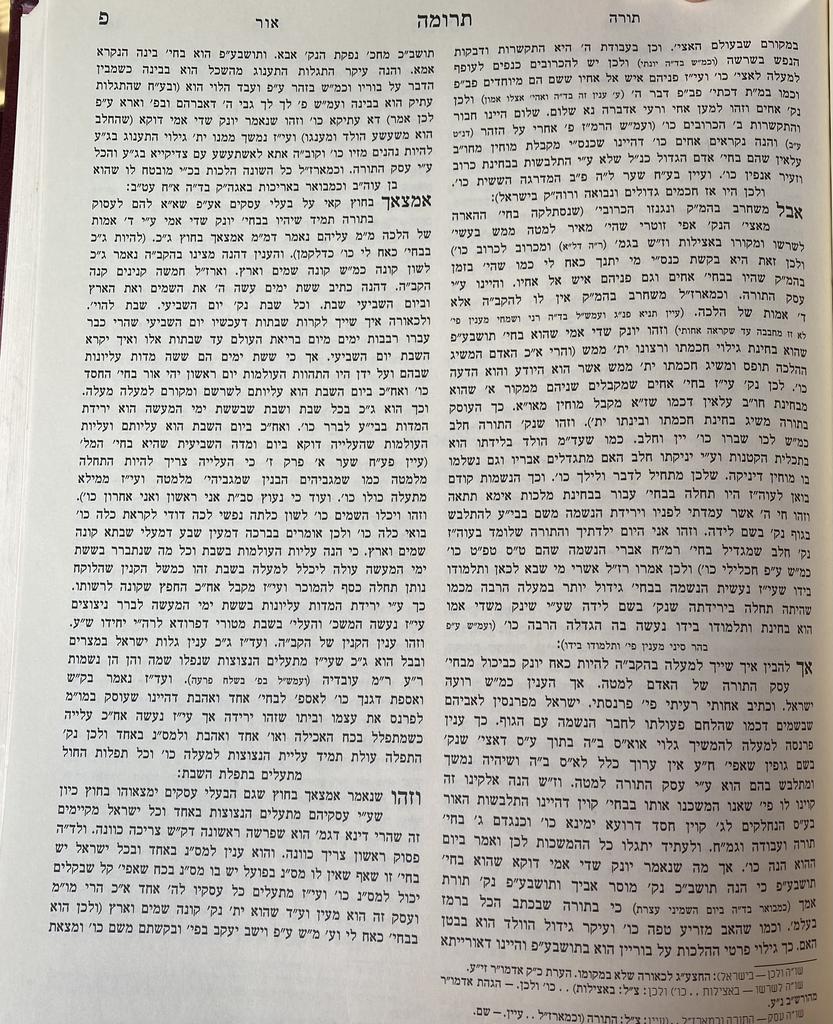
Parasahat Trumah
Friday February 19, 2021
Translation and Commentary of Parashat Trumah which appears in the book Torah Or
by Rabbi Shneur Zalman of Liadi
Translation and Commentary by Rabbi Gedaliah Potash and William Schecter, MD
This draft has been neither edited nor approved by Rabbi Potash
Rabbi Potash opened the discussion of the Elter Rebbe’s comment by saying: This week’s Parasha discusses the construction of the Mishkan, a small but powerful edifice that controls the relationship between the Jewish People and G-d. G-d is giving the Jewish People a project and through their efforts, the Jewish People will have buy in to the relationship with G-d. The Jewish People could use their creativity to create the Mishkan. Rabbi Potash quoted the Zohar: ממטה למעלה (from below to above) to describe the role of the construction of the Tabernacle by the Jewish People in a sense reaching up to G-d. The sense of Holiness in the Mishkan lasted much longer than the Holiness of Mount Sinai. We don’t know exactly where Mount Sinai is and it is no longer considered a Holy Place as opposed to the Mishkan which lasted for about 500 years and then reappeared, so to speak, with the construction of the Holy Temple
The Elter Rebbe begins his discussion with a quotation from the Song of Songs: “ If only it could be as with a brother, As if you had nursed at my mother’s breast: Then I could kiss you” (Song of Songs 8: 1) This quotation represents the community of Israel’s request to G-d concerning the time of the Exile to return to the time that the Holy Temple existed when Israel was called the brothers of G-d as it is written למען אחי ורעי (for the sake of my brothers and friends—Psalm 122:8) and afterwards it is written :”for the sake of the Lord our G-d…” (Psalm 122:9) that is to say, the Jews were referred to as brothers during the time of the Holy Temple and therefore now (in the time of Exile) the community of Israel requests “If only it could be as with a brother” once again.
The Elter Rebbe now launches into a discussion of the Cherubs which were carved on the Holy Ark. Re: the Cherubs which were in the Holy Temple it is written that they were facing each other. It is written: “you shall make two Cherubs….” (Exodus 25:18) “one Cherub on one side (of the Ark)……” (Exodus 25:19) The Rabbis in the Talmud described the Cherubs1 in greater detail by saying each Cherub had the face of a human, one being an adult and the other being a child (Chagigah 13: b).
On the Chariot (Throne), there was the image of a Man, but we must understand that this is not the image of a physical body. Rather, the Torah is called “Man”, meaning that the Rabbis of the Talmud considered that the entire Torah contained all the Names of G-d and the Ten Sefirot are called the Names of G-d (Zohar), Rabbi Potash explained: In Ezekiel’s Vision (Ezekiel 1) he describes a Chariot (Throne) upon which is seated the image of a Man who then speaks to Ezekiel saying “He said to me, “O mortal, I am sending you to the people of Israel, that nation of rebels, who have rebelled against Me.—They as well as their fathers have defied Me to this very day …….for the sons are brazen of face and stubborn of heart. I send you to them, and you shall say to them: ‘Thus said the Lord GOD’—” This passage is troubling as it raises the question “How can we assign an image of G-d in the form of Man when G-d has no form?” The Elter Rebbe explains that Adam is a metaphor for the Torah. Adam is a metaphor for multilayered existence. The form does not sum up the totality of what a person is. The same thing is true with Torah. Through the study of Torah, we are connected to G-d’s wisdom. Just like when we shake someone’s hand, we don’t have mastery over him. G-d makes Himself accessible to us through Torah but it is not the sum total of what G-d is. The entire Torah is like G-d’s name (Zohar). Your name isn’t really you. It calls attention to you but doesn’t really define you. Just like when you call someone’s name, they answer, so when we read Torah, G-d is with us. The Elter Rebbe says we can understand the 10 Sephirot as the 10 names of G-d.
The Elter Rebbe continues: “By way of example, just as a man is called Abraham or Jacob, this name does not touch the essence of the man, which comprises his particular intellect and qualities. If this is so, he really does not need his name which is external to his core being and is useful only to draw his attention when one is calling to him.
So too regarding G-d: even His Supernal Intellect, not to speak of the other Supernal Qualities, have no value at all vis à vis G-d’s true Essence, for His Essence is above the confines of Wisdom and the existence of the 10 Sefirot comprising the 10 Names of G-d, which is only the light in the World which does not touch to the Essence. Rabbi Potash commented: Even though we attribute the 10 Sephirot to G-d, any Sephirah or attribute is distant from the true nature of G-d. His essence is not defined by those names.
And here it is written: G-d in Wisdom is the revelation of this light which has the attribute of the Name of G-d as it is written “I am the Lord this is my Name it has the attribute of Wisdom and through Wisdom the Eternal Light is drawn down in all 10 Sefirot ….. and therefore Wisdom of Adam (Man) is called the First Man and in the Zohar אדם קדמא (Adam Kadma—primordial man)3 For the first Wisdom is analogous to the dispersion and drawing down of the light and vitalization of the Soul in the body that the revelation of the entirety of Life is drawn from the Soul which enlightens and invests the intellect in the head and through the intellect the light (energy) is subsequently drawn down to each organ, each receiving enough energy for its specific purpose. So, the entire vitality (energy) required by all the organs of the body is found in the brain. Just as the intellect vitalizes all the organs of the body, by way of analogy, the revelation of the Eternal Light above is drawn down and invests in the Wisdom and by way of this Wisdom, the Light is drawn down and invests the 10 Sefirot. If so, the Torah is produced from Wisdom and is called Adam (Man). The Elter Rebbe here is explaining why the Man in Ezekiel’s Vision is a metaphor for the Torah and not G-d (because G-d is unknowable and not subject to description despite the troubling passage in Ezekiel I).
The Elter Rebbe now goes on to quote Sefer Hadarat HaMelech by saying the 248 positive commandments are analogous to the 248 organs of the body and the 365 negative commandments are analogous to the 365 tendons of the body and the Talmud brings to action for the light is drawn from the intellect to each organ thus connecting the Torah to G-d.
Rabbi Potash explains יהו׳ (the Tetragram) means He was, He is, He will be. Just as in the human experience, the Life force is drawn from the brain throughout the body—Chochmah is the origin of the life force within the body. Just as in the body, in the metaphor of the Sefirot, Chochmah is the life force for the rest of the Sefirot. The Sefirot are not all equal. Chochmah is the Highest Sefira which is the life force for the rest of the sefirot. Just as all the organs of the body are dependent on the life force from the brain. So too, all the other Sefirot are dependent upon the Life Force from the Sefiirah of Chochmah. יהו׳ is the origin of all creation. Each part of the world is getting a different kind of energy according to it needs .
The Torah is supernal in order to be the drawing force of Supernal Wisdom to be invested in the Torah in the World of Briah through the process of contraction (Tsimtsum—Contraction of the Supernal Energy). The Rabbis of the Talmud commented that the Divine Presence (Shekinah) contracted between the two ends of the Holy Ark (carrying the 10 commandments and a copy of the Torah written by Moses). And because the Voice of G-d spoke to Moses from there (the Holy Ark), the face of the Cherub is called the Child (because of the contraction—making smaller of the Divine Light {Energy}) or the Small Man because the revelation in its intellect more contracted than in the Adult (the Great Man).
And here the attribute of man is called Adam Gadol (the Great Man) compared to the face of the adult in the carved Cherub of the Holy Ark because the Supernal Wisdom is the attribute of the Eternal and as it is written “His wisdom cannot be fathomed” (Isaiah 50:28) for He is the One who knows and He is Knowledge. So, the first Cherub at one end of the Ark represents the drawing down of the Light from above to below to be the source and root of the drawing down of the Light (Energy) to the Worlds of Briah, Yetzirah and Asiyah. And the Cherub opposite this one represents the awakening from below during the recitation of the Shm’a to transmit to his Soul the Love (of G-d—which begins the second paragraph of the Shm’a). And through the Shm’a, Israel contemplates how the Lord is One, how He is unchanging, how He uttered a Word and the World came into existence, because he commanded and created…….and everything else is insignificant compared to G-d. And through this contemplation will come the transmission to the Soul of “And having You, I want no one on earth.” (Psalm 73:25) Therefore, the entire community of Israel is referred to as “craving” (a relationship with G-d) from below to above. So, there is a two way relationship here. On the one hand, G-d is reaching down to us through the process of creation and then contraction of his Eternal Light to reach our World, and we, through desire and craving reach up to G-d to establish a relationship.
And this is the attribute of Cherub on this end (of the Ark) to arise from the Worlds of Briah, Yetzirah and Asiyah and to be absorbed into the Eternal Light to gaze upon the dearness of the King (G-d) as in Our Eyes are lifted towards G-d. And through this, the “Waters of the Face” are brought down from on high and we can gaze upon the reflection of G-d in the waters. (Proverb 27:19).“And from the cover of the Ark you shall make Cherubs” ( Exodus 25:19 )4 this is the attribute of “encircling all the worlds”
.
The two faces of the cherubs refer to the a large great person and the other is a smaller person—representing the two levels a higher level and a lower level. The adult face refers to the process of flow of energy to the rest of the world which takes place on the level of Atzilut. But in order to continue down to the chain system, the energy needs to go down to the next level—Briah At this level, there must be a contraction of the energy and then go through the same process from intellect (Chochmah) to the rest of the world. This process continues until it gets down to our world of physical existence. This means that there is an element of tsimtsum between the poles of the Ark so there is a contraction in the Kodesh HaKodeshim (the internal portion of the Mishkan containing the Ark).
There were 2 cherubs one from one side and the other on the other side. There was a flow from the greater to the smaller cherub. So too, G-d too gives his energy to us. The cherubs represent the highest flow of energy from G-d but also the relationship we have with G-d.
- Cherub: The Talmud defines a Cherub: “The Gemara asks: What is the meaning of “cherub”? Rabbi Abbahu said: Like a baby [keravya], for in Babylonia they call a baby ravya”-- מַאי כְּרוּב אָמַר רַבִּי אֲבָהוּ כְּרָבְיָא שֶׁכֵּן בְּבָבֶל קוֹרִין לְיָנוֹקָא רָבְיָא (Chagigah 13: b)
- Ezekiel I: “וּמִמַּ֗עַל לָרָקִ֙יעַ֙ אֲשֶׁ֣ר עַל־רֹאשָׁ֔ם כְּמַרְאֵ֥ה אֶֽבֶן־סַפִּ֖יר דְּמ֣וּת כִּסֵּ֑א וְעַל֙ דְּמ֣וּת הַכִּסֵּ֔א דְּמ֞וּת כְּמַרְאֵ֥ה אָדָ֛ם עָלָ֖יו מִלְמָֽעְלָה׃
Above the expanse over their heads was the semblance of a throne, in appearance like sapphire; and on top, upon this semblance of a throne, there was the semblance of a human form.
- To explain the difference between Primordial Man (Adam Kadmon or Adam Kadma) and Adam Rishon (the First Man=Adam), I am copying a piece that I found in Wikipedia which is the simplest explanation I have found to date of Kabbalistic Cosmology. Here it is: In Kabbalah, before creation began, all that existed was God's Infinite Light. The first stage of creation began when God contracted His Infinite Light to create the vacuum. Then a ray of divine light penetrated the vacuum and the persona of Adam Kadmon was projected into the vacuum. The first stage of Adam Kadmon was in the form of ten concentric circles (igulim), which emanated from the ray. The ray of light was then enclothed by the anthropomorphic form of Adam Kadmon (yosher), which is a realm of infinite divine light without vessels, constrained by its potential to create future Existence. Adam Kadmon is sometimes referred to as Adam Ila'a (Aramaic: "upper man") or Adam Elyon (Hebrew: "upper man").
The soul of Adam HaRishon ("the first man") was the supreme essence of mankind. It contained within it all subsequent souls. In the midrash, he is sometimes referred to as Adam HaKadmoni ("the ancient man"),[6] Adam Tata'a (Aramaic: "lower man") or Adam Tachton (Hebrew: "lower man").
The anthropomorphic name of Adam Kadmon denotes that it contains both the ultimate divine purpose for creation, i.e., mankind, as well as an embodiment of the Sefirot (divine attributes). Adam Kadmon is paradoxically both "Adam" and divine ("Kadmon-Primary").
Adam Kadmon preceded the manifestation of the Four Worlds, Atzilut ("emanation"), Beriah ("creation"), Yetzirah ("formation") and Asiyah ("action"). Whereas each of the Four Worlds is represented by one letter of the divine four-lettered name of God, Adam Kadmon is represented by the transcendental cusp of the first letter Yud.
In the system of the sefirot, Adam Kadmon corresponds to Keter ("crown"), the divine will that motivated creation.
The two versions of Kabbalistic theosophy, the "medieval/classic/Zoharic" (systemised by Moshe Cordovero) and the more comprehensive Lurianic, describe the process of descending worlds differently. For Cordovero, the sefirot, Adam Kadmon and the Four Worlds evolve sequentially from the Ein Sof (divine infinity). For Luria, creation is a dynamic process of divine exile-rectification enclothement, where Adam Kadmon is preceded by the Tzimtzum (Divine "contraction") and followed by Shevira (the "shattering" of the sefirot).
4. Ark see illustration below
Parashat Trumah 3
From Torah Or
By Rabbi Shneur Zalman of Liadi
Translation and Commentary by Rabbi Gedalia Potash and William Schecter, MD
Thursday February 3, 2022
This section begins on page 158, column 2, third paragraph
And here it is written “The cherubim shall have their wings spread out above, shielding the cover with their wings. They shall confront each other, the faces of the cherubim being turned toward the cover.”and in the Zohar Parashat Achrei and in Veyehi, it is said that three times a day the cherubim spread their wings to flutter, etc. The Ramaz (The nickname of Rabbi Mordechai Zachut, 17th century Amsterdam Kabbalist) interpreted this to mean that this occurs at the time of the three daily prayers meaning during the three times of daily prayer the Cherubs ascend from the worlds of Briah, Yetzirah and Asiyah to the World of Atzilut and this is what is meant by the Cherubs fluttering their wings, by awakening the love and awe that is in Israel The love and awe are called wings and the cherubs ascended on high. And then they are called the “great man with the face of a fully developed adult” because their Prayer ascended to Atzilut in which the Divine, the Light in the Sephirot and the Vessels of the Sephirot are all one entity and therefore the relationship of Tfilah (prayer) to connection is like the relationship of Naftali is to Niftalti (see comment for explanation). And so in the words of the Mishnah “Hatofel kli cheres” (the person who prays—see comment for explanation) joins with the Source in the world of Atzilut.
Comment:
This last sentence requires explanation. The Elter Rebbe is comparing the word for prayer (תפילה –Tfilah) with a phrase from the Mishnah טּוֹפֵל כלי חרש (Hatofel kli cheres) (Masechet Kalim, Chapter 3, Mishnah 5)
This rather obscure Mishnah states: ” טּוֹפֵל כְּלִי חֶרֶס הַבָּרִיא, רַבִּי מֵאִיר וְרַבִּי שִׁמְעוֹן מְטַמְּאִים. וַחֲכָמִים אוֹמְרִים, הַטּוֹפֵל אֶת הַבָּרִיא, טָהוֹר. וְאֶת הָרָעוּעַ, טָמֵא. וְכֵן בְּחִדּוּק הַקֵּרוּיָה
: One who lines a sound vessel: Rabbi Meir and Rabbi Shimon say: [the lining] contracts impurity. But the sages say: a lining over a sound vessel is not susceptible to impurity, and only one over a cracked vessel is susceptible. And the same dispute applies to the hoop of a pumpkin shell
The point the Elter Rebbe is making is that if a vessel contracts impurity but is pieced together ()טּוֹפֵל, it becomes pure. Similarly, through prayer (תפילה) a broken person can be made whole and complete. I would note that although Tfilah and Tofel sound similar Tofel is written with a ט and Tfilah with a ת The explanation is that Tofel comes from the word Tefel (טפל ) meaning subordinate. So that through prayer man subordinates himself and achieves nullification so that he can achieve a true intimate connection with G-d.
The last phrase in the sentence refers to the Hebrew words Naftali and Niftalti. The Elter Rebbe is using the story in Genesis in which Rachel, who is childless, is in competition with her elder sister Leah who has already born children. Rachel therefore gives her maidservant to Jacob as a concubine and she conceives first Dan and then a second son. Rachel then says and I quote:
“וַתֹּ֣אמֶר רָחֵ֗ל נַפְתּוּלֵ֨י אֱלֹהִ֧ים ׀
נִפְתַּ֛לְתִּי עִם־אֲחֹתִ֖י גַּם־יָכֹ֑לְתִּי וַתִּקְרָ֥א שְׁמ֖וֹ נַפְתָּלִֽי׃
And Rachel said, “A fateful contest I waged*A fateful contest I waged Heb. naphtule … naphtalti, connected with “Naphtali.” Lit. “A contest of God….” with my sister; yes, and I have prevailed.” So, she named him Naphtali. The boy was named Naftali but the question has been debated, what does niftalti really mean. Rashi in his commentaries, quoting Onkelos’ translation of the Torah to Aramaic, says the word really refers to prayer. Here are his words:
“גם יכלתי AND I HAVE PREVAILED — He has yielded to my importunities. Onkelos translated it in the sense of prayer (תפלה), in this way: נפתולי אלהים נפתלתי means prayers that were pleasing to God I offered and I was accepted and was answered like my sister.
So, in summary, the Elter Rebbe is using these two examples to point out that at the time of prayer when the Cherub wings are said to flutter and ascend to the world of Atzilut, the prayer serves as a mechanism to create a close intimate connection with G-d.
The service of G-d it is a connection and cleavage of the soul to its root. And therefore, the cherubs have wings to fly above to Atzilut etc. and they face each other and there they are united face to face. This is what is meant by “for the sake of my brothers and friends I will speak peace”.
Comment:
לְ֭מַעַן אַחַ֣י וְרֵעָ֑י אֲדַבְּרָה־נָּ֖א שָׁל֣וֹם בָּֽךְ׃
For the sake of my brothers and friends,
I pray for your well-being; (Psalm 122:8)
Peace meaning the joining and connection of the two cherubs etc. And here they are called brothers etc meaning that the Knesset Israel receives its intellect from supernal Hochmah and Binah which are the attributes of the great man as discussed above and not through the investment in the attribute of the cherub and the small face etc. And therefore there will be great sages and prophecy and the Holy Spirit in Israel.
But then the Holy Temple was destroyed and the Cherubs were stored away. And therefore this is the request of the Knesset Israel:
“מִ֤י יִתֶּנְךָ֙ כְּאָ֣ח לִ֔י יוֹנֵ֖ק שְׁדֵ֣י אִמִּ֑י אֶֽמְצָאֲךָ֤ בַחוּץ֙ אֶשָּׁ֣קְךָ֔ גַּ֖ם לֹא־יָבֻ֥זוּ לִֽי׃
If only it could be as with a brother,
As if you had nursed at my mother’s breast:
Then I could kiss you
When I met you in the street,
And no one would despise me. (Song of Songs 8:1)
The Cherubs in the time of the Holy Temple had the attribute of brothers facing each other, meaning through engagement in Torah study. As the Talmudic sages said when the Holy Temple was destroyed G-d had only 4 amot of Halacha.
Discussion: This is a very confusing sentence. Rabbi Potash explains. An Amah is a cubit, the distance from the tip of the third (long) finger to the elbow. Halacha means the path or way and is a synonym for Jewish Law as developed in the Talmud (the Oral Law) as opposed to the Written Law (the written Torah). The written Torah states the principles and the Oral Torah develops those principles as they apply to many situations in daily life.
The use of Halacha in this sentence is a play on words. One is forbidden to get closer than 4 amot to someone who is praying with Kavanah (Intent) so as not to interfere with his attempt to have an intimate relationship with G-d. So when the Temple was destroyed in 70 CE, we lost the ability to get close to G-d in His dwelling place and the sacrifices were replaced by prayer. It is through Torah Study (and by this the Elter Rebbe means study of both the written and oral Torah) that we can draw down the Infinite Divine Light and connect with G-d.
And this is what is meant by “he nurses from the breast of my mother” (Song of Songs 8:1) which is the attribute of the Oral Law which has the attribute of revelation of his true wisdom and desire . And the Torah is called milk as it is written “go and break etc. wine and milk. As an example, when a baby is born he is tiny and by being suckled with his mother’s milk, his organs grow and his brain matures through the nursing process. As a result, he begins to speak and walk. Similarly, the souls prior to their coming to this world were like a fetus with the attribute of malchut imah detatah
Discussion: The Kabbalistic expression “Malchut Imah tatah ( מלכות אימא תתאה ) refers to the Sephira of Malchut in the World Atzilut (the lowest Sephira which is why it is called the Lower mother of Malchut (Malchut Imah Tatah). This refers to the Divine Light which flows down to the lower worlds of Briah, Yetzirah and Asiyah from Malchut in the World of Atzilut (Malchut Imah Tatah).
Malchut Imah Tatah is differentiated from Imah Ila’ah (Supernal Mother) which receaves its Light from Aba Ila’ah in the Sephirah of Hochma (Wisdom) in the world of Atzilut.
and this is the meaning of “As the LORD lives, the God of Israel whom I serve”
Discussion: This somewhat confusing quotation from Kings 17:1 requires the full quote:
“וַיֹּ֩אמֶר֩ אֵלִיָּ֨הוּ הַתִּשְׁבִּ֜י מִתֹּשָׁבֵ֣י גִלְעָד֮ אֶל־אַחְאָב֒ חַי־יְהֹוָ֞ה אֱלֹהֵ֤י יִשְׂרָאֵל֙ אֲשֶׁ֣ר עָמַ֣דְתִּי לְפָנָ֔יו אִם־יִֽהְיֶ֛ה הַשָּׁנִ֥ים הָאֵ֖לֶּה טַ֣ל וּמָטָ֑ר כִּ֖י אִם־לְפִ֥י דְבָרִֽי׃ {ס}
Elijah the Tishbite, an inhabitant of Gilead, said to Ahab, “As the LORD lives, the God of Israel whom I serve, there will be no dew or rain except at my bidding.
I believe that the Elter Rebbe is implying that the descent of the souls from the world of Atzilut to our netherworld—Asiyah—occurs only due to G-d’s Will.
The process of the descent of the soul from Atzilut to Briah, Yetzirah and Asiyah to be enclothed in the body is called birth. This is the meaning of “Let me tell of the decree: the L-RD said to me, you are My son, I have fathered you this day.” אֲסַפְּרָ֗ה אֶֽ֫ל־חֹ֥ק יְֽהֹוָ֗ה אָמַ֘ר אֵלַ֥י בְּנִ֥י אַ֑תָּה אֲ֝נִ֗י הַיּ֥וֹם יְלִדְתִּֽיךָ׃ (Psalm 2:7). Meaning the Torah that he studies in this world and is called milk that causes the 248 organs of the soul to grow…………. And therefore the Sages said “Happy is the one who arrives with his studies in hand” (Baba Batra 10: b:6).Through study of Torah the soul is greatly magnified to the level it occupied prior to its descent. The descent is called birth. After the birth, the soul was suckled from the breast of its mother which is the attribute of his “Talmud (study of the Torah) in his hand” that greatly enlarged the soul.
Comment:Torah study is compared to mother’s milk which enables the soul to grow and mature after its descent (birth) to our netherworld of Asiyah.
But we must understand how the soul belongs above with G-d to be as a brother figuratively being suckled by Torah Study of the man below. But the issue is as it is written Shepherd of Israel (G-d). And it is written “My sister my bride” meaning the one who sustains me.
Discussion:
What is the Elter Rebbe talking about here. The Shepherd of Israel is a metaphor for G-d. My sister my bride refers to Israel
Israel sustains their father in Heaven just as bread connects the soul with the body. Sustaining above draws down the revelation of the Infinite Light within the 10 Sephirot of Atzilut which are called bodies. Even the supernal Hochma (Hochma Il’ah-- חוכמה עילא - ח״ע ) has no comparison at all to the Infinite Light that shall be drawn down and enclothed with them through Torah study below (in our world). And this is what is meant by
“וְאָמַר֙ בַּיּ֣וֹם הַה֔וּא הִנֵּ֨ה אֱלֹהֵ֥ינוּ זֶ֛ה קִוִּ֥ינוּ ל֖וֹ וְיוֹשִׁיעֵ֑נוּ זֶ֤ה יְהֹוָה֙ קִוִּ֣ינוּ ל֔וֹ נָגִ֥ילָה וְנִשְׂמְחָ֖ה בִּישׁוּעָתֽוֹ׃
In that day they shall say: This is our God;
We trusted in Him, and He delivered us.
This is the LORD, in whom we trusted;
Let us rejoice and exult in His deliverance!” (Isaiah 25:9)
Discussion: We must pause here for a bit of etymology in order to understand the Elter Rebbe’s argument. The expression: “הִנֵּ֨ה אֱלֹהֵ֥ינוּ זֶ֛ה קִוִּ֥ינוּ ל֖וֹ” is translated as “This our G-d, we trusted him. It could also be translated as “this is our G-d, we have hoped for Him”. The three consonant Hebrew root for “to hope” is קוה. The Hebrew word for line or cord is קו so there is a connection between the passage in Isaiah referring to trusting in or waiting for G-d and the “lines” to which the Elter Rebbe will now refer.
meaning that we drew him down with the attribute of lines meaning the investment of the Light in the 10 Sephirot which are divided into 3 lines, Chesed on the Right “arm” and opposite them the three attributes of the Torah and Service and Gemilut Hasadim. And in the future all the drawings down will be revealed and therefore he said “וְאָמַר֙ בַּיּ֣וֹם הַה֔וּא הִנֵּ֨ה אֱלֹהֵ֥ינוּ זֶ֛ה קִוִּ֥ינוּ ל֖וֹ וְיוֹשִׁיעֵ֑נוּ זֶ֤ה יְהֹוָה֙ קִוִּ֣ינוּ ל֔וֹ נָגִ֥ילָה וְנִשְׂמְחָ֖ה בִּישׁוּעָתֽוֹ׃
In that day they shall say:
This is our God;
We trusted (or hoped for) in Him, and He delivered us.
This is the LORD, in whom we trusted;
Let us rejoice and exult in His deliverance! (Isaiah 25:9)
It was said “mother’s breast suckles is that the attribute of the Oral Law because here the Written Law is called the Musar of your Father and the Oral Law is called your Mother’s Torah because in the written Torah everything is a hidden hint. This is analogous to the father impregnating the mother with a drop of semen. The resulting fetus then grows in the mother’s womb. Such that the revelation of the details of the Laws to their depths occurs in the Oral Law meaning that the written Torah was produced from Wisdom which is called Father. And the Oral Law is the attribute of Understanding which is called Mother. And here the principle of the revelation is the delight from the intellect is in understanding-when he understands the issue to its depts as it is written in the Zohar aying pay “and the Levi worked he da atika etc. and this is that is said the breast of the mother suckeled (that the milk is what entertains the baby and delights him) and by this is drawn from Him the revelation of the delight in Gan Eden and G-d comes to enjoy the company of the Tsadikim in Gan Eden and al this occurs through Torah Study. . The Talmudic Sages said “All who teach the Halachot in the Knesset Israel are promised a place in the world to come.
We completed the translation and discussion to page פ column 2, end of first paragraph