21 Cheshvan 5775 | November 14, 2014
Parshat Chayei Sarah
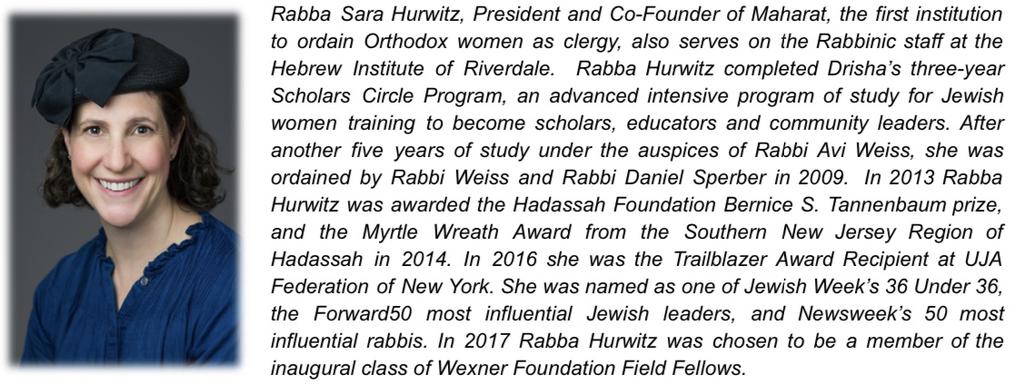
Rabba Sara Hurwitz
President and Co-Founder
Parshat Chayei Sarah begins with the death of Sarah. The Torah tells us that Avraham cried bitterly.
וַיָּבֹא֙ אַבְרָהָ֔ם לִסְפֹּ֥ד לְשָׂרָ֖ה וְלִבְכֹּתָֽהּ׃
And Avraham came to eulogize Sarah, and bewail her.
Remarkably, this is the first act of mourning in the Torah, despite the fact that death has already appeared prominently. As such, we read this narrative as a paradigm for how future generations should go about mourning.
Thus, the mefarshim (commentators) examine Avraham’s response and behavior, specifically, how he cried. Our attention is immediately drawn to the word “l’vchotah” (to bewail her) because the letter kaf in this word is smaller than the other letters. Poetically, it is this “kaf,” according to the mefarshim, with its diminutive size, which captures the visceral and diminished emotional state of Avraham.
Rashi writes that Sarah’s death was directly connected to the binding of her son; the moment she heard that Yitzchak had almost been slaughtered “her soul fled from her.” Perhaps, then, the smaller kaf implies that Avraham is weeping tears of guilt, as it was his actions which led to Sarah’s death.
Ramban suggests that Avraham came from (וַיָּבֹא) his tent to Sarah’s tent with a group of his friends to bewail her. The small kaf, then, may represent a devastated, bent over man being surrounded and supported by his community of friends and neighbors.
The Ba’al Haturim suggests that the kaf is written smaller than the other letters to indicate that Avraham only cried for Sarah for a short time. “He did not mourn extensively, because she was old and had lived a full life.” The small kaf, perhaps, represents tears of nostalgia or appreciation for time Avraham and Sarah spent together.
Shimshon Raphael Hirsch suggests that the diminutive form of the kaf indicates that although his grief was infinite, the full extent of Avraham’s mourning, his weeping and grief, was kept private, in the confines of his home. The kaf is smaller to represent the internal, almost hidden and private nature of Avraham’s tears.
The Torah tells us Avraham cried, but we can only surmise how he actually felt. It is impossible for the commentators to agree on how Avraham mourned, because there is no one right way. There are times that our tears are joyful or nostalgic, as we reflect on the blessed and long life a loved one lived. At times we cannot cry at all in front of others, and we sob, uncontrollably, in the solace of our bedrooms. Sometimes we cry because we weren’t the child or sibling we wanted to be and we shed tears of guilt and regret. Sometimes, our tears are so devastating and debilitating that we rely on our friends to lift us figuratively and literally out of our deep despair.
In short: there is no one way to mourn.
One last interpretation: if you remove the small kaf altogether, we are left with two words “v’lev tah,” meaning "and to have a heart for her.” Avraham’s grief is sincere and from the heart. His tears model for us the many and varied ways to grieve, and so demonstrates that there is no right way to cry when a loved one dies. But at the core of his grief is the hole, the missing “kaf” that Avraham now feels in his heart, as he mourns, in his own personal way, for his beloved wife.
Rabba Sara's Overarching Theme:
Feeling God’s presence, shouldn’t be that difficult. “You shall walk after the Lord your God,”(Devarim 12:5) we are told; seek out God’s presence. And yet, astonished, R. Hama son of R. Hanina (Talmud Bavli, Sotah 14a) asks, how is it possible to walk with the Shechina? Rav Hama quotes an early pasuk from Devarim that describes “... the Lord your God as a devouring Fire.”(Devarim 4:24). How is it possible to get close to God without being scorched? R. Hama answers his own question: We must walk after the midot, after the attributes of God, not his immediate presence.
In Hebrew, good attributes, midot, are translated as “good measures.” Rabbi Adin Steinsaltz in The Thirteen Petalled Rose, suggests that a quality is determined by its proportion. In other words our midot are the balance of our varied characteristic traits. To act Godly is to put our best spiritual essence forward, while trying to keep in check the inevitability of negative attributes. We are at once both good and bad, compassionate and injurious.
At Yeshivat Maharat, our students are ordained with the ability to lead, pasken, and teach. But, they must also be finely attuned to the nuances of the human condition. Spiritual leaders are most effective when they have confronted and understand their own midot, their own balance of human traits. Our Torah narratives bring to bare the multi-layers of the characteristic traits that individuals must learn to balance within themselves.
And so, I offer this weekly parsha column as a model of Yeshivat Maharat’s Pastoral Torah curriculum, where we will explore the rich and varies layers of the human condition.