12 Iyyar 5775 | May 1, 2015
Parshat Acharei Mot-Kedoshim
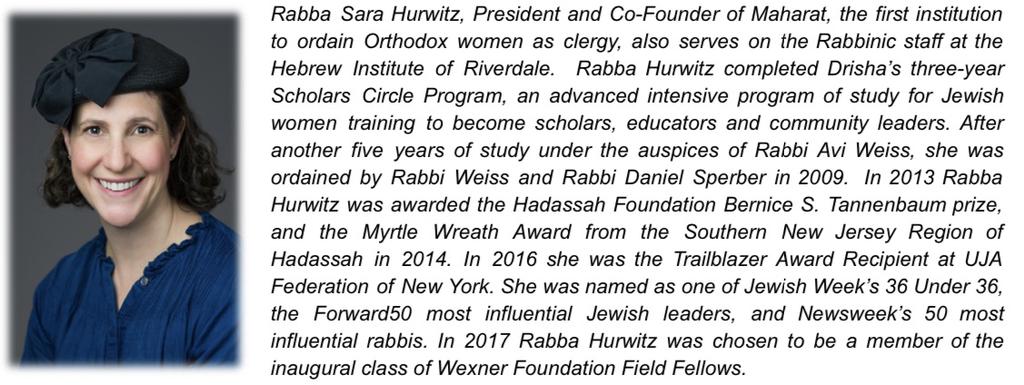
Rabba Sara Hurwitz
President and Co-Founder
At the end of Acharei Mot, the Torah instructs:
Do not perform the practices of the land of Egypt in which you dwelled, and do not perform the practice of the land of Canaan to which I bring you, and do not follow their traditions.
What are the abominable practices that God commands that we stay away from? The Torah goes on to list the arayot (forbidden sexual liaisons) that one must refrain from—more specifically the prohibition of engaging in incestuous relationships. These incestuous relationships, the Torah explains, are the unethical practices of the Canaanites. Ma’ase Ca’naan, incestuous relationships, are practices that degrade and debase the individual. The term describes practices that eradicate any notion of cohesive family; one that does not allow for individual and committed expression of love.
The Torah, however does not explicitly explain what ma’ase Mitzrayim are. What are the ways of the Egyptians that we must shun?
One of the first time that the Jewish people engaged with the Egyptians, even before the Jews became slaves, is when the brothers came down to Egypt to acquire food from the viceroy, from their brother Yosef. Yosef invites his guests to dine with him. The Torah illustrates the scene in Bereishit 43:31-32. Yosef commands his servants to serve food (שִׂימוּ לָֽחֶם). They served Yosef’s food separately and the brothers’ food separately, and the Egyptians who ate with them separately. Why? The pasuk explains that the Egyptians could not bear to eat with the Hebrews because it was an loathsome to them (כִּי-תוֹעֵבָה הִוא לְמִצְרָיִם).
Ma’ase Mitzrayim, which God commands the Jewish people to avoid, is the audacity of separatism. It is hard not to think of the separatist laws passed in Nazi Germany—forbidding Jews from eating with, sitting with, working with or marrying Aryans. This separatism was a natural progression towards complete oppression. So too with Mitzrayim. First, the Egyptians demanded that the Jews eat separately. Then, they insisted that they settle in a separate area in Egypt, and ultimately, the separatism lead to oppression and slavery.
But what, if anything, does this imperative have to offer us today? After all, we live in a world that for the most part, does not condone illicit sexual relation. In the US, every state has some form of codified prohibition against incest. And, since the Civil Rights movement, discrimination is outlawed and hate crimes against others of different race or religion is severely punished. Surely this plea, not to be like the Egyptians and the Canaanites cannot apply to each of us today?
And yet, the essence of ma’aseh Ca’naan and ma’aseh Mitzrayim do still exist today. The ma’ase Ca’naan, who engaged in these arayot (forbidden sexual relations) is describing a society that eradicates any sense of boundaries. The natural order of relationships is shattered, making way for unions with parents or siblings that are unnatural and unsustainable. It describes a community with no prohibitions or laws. And the ma’ase Mitzrayim, the practices of the Egyptians, who are bent on oppression is a society that upholds separatism as its greatest value. Unlike the Canaanites who know no boundaries, the Egyptians, are on the other extreme—they embrace distinction, categorizing one group of people as more superior and distinct than another.
We must not be like the Mitzrim, a people bent on discrimination. And we must not be like the Canaanites who don’t discriminate at all between appropriate and inappropriate relationships. Rather, we should strike a balance, and uphold the Torah’s mandate, just a few pasukim later of
וָחַ֣י בָּהֶ֑ם
And you shall live by them.
Using the Torah and God’s decrees as our guiding principles, we must carve out a life that is tenable, one where we can fully function and live. It is, I believe, a call to find the right balance—a balance between a life that knows no boundaries and one that looks to create too many strictures and limitations. A life of shunning, entirely, ma’aseh Ca’naan and ma’aseh Mitzrayim.