13 Elul 5778 | August 24, 2018
Parshat Ki Tetze
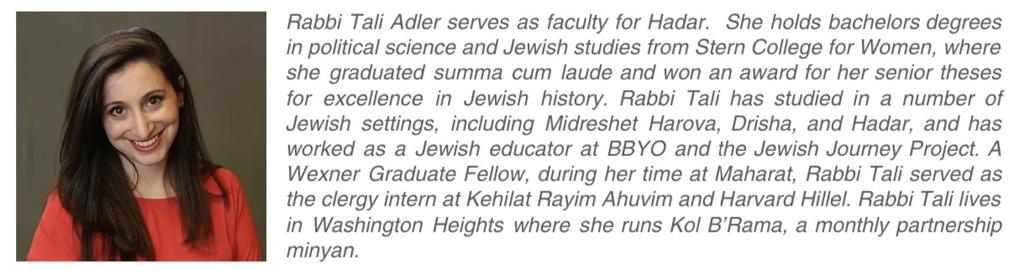
Rabbi Tali Adler
Class of 2018
I was eight years old, on vacation in Basel, Switzerland, the day I learned about memory.
It was a chilly, autumn shabbos, and my father and I were on a walk by the river. My father pointed out different sights as we walked: there is the house where his elementary school friend lived. There is the gate they walked through to get to school, there is the shop run by the woman rumored to be a witch. And there, he said pointing to a small, shady area, is the place where they burned the Jews in the 14th century.
The rest of the afternoon was like a double exposure: there are the roasted chestnuts, there is the witch, and there is the place where they burned the Jews. For the first time, I began to understand what it is like when something so beautiful becomes, while retaining all its magic, something terrible as well.
This week’s parsha is full of reminders of the power of memory. Many of these memories are exclusively dark: we are commanded never to allow someone from Ammon or Moav to join the Jewish people because they would not sell us food or water when we left Egypt. We are reminded of how the Moavim hired Bilaam to curse us. We are commanded never to forget what Amalek did to us when they attacked us on our way out of Egypt.
Other memories are redemptive: we are commanded to remember that we were slaves in Egypt and that God freed us. That memory, the memory both of the slavery and the freedom, is given as the reason we may not be unjust to widows, orphans, and the poor.
There is one memory, however, that seems impossible to classify as either dark or redemptive. In perek 23, pasuk 8, we are commanded: lo titev mitzri, ki ger hayita b’artzo. You may not hate an Egyptian, because you were a stranger in his land. In memory of the time we spent there as strangers, we are commanded never to hate them, and to allow Egyptians, after several generations, to join the Jewish people.
Most of our associations with Egypt and the Jewish people are images of suffering. Rashi, in his comment on this pasuk, highlights this suffering in the starkest possible terms: You may not despise an Egyptian, even though they threw your babies into the Nile. Even though you endured terrible suffering there, even though it is the paradigm for persecution. Why? Because you were a stranger in his land. Because, Rashi explains, they hosted you in a time of a dire need.
Once, generations earlier, Egypt was a place of safety for Yaakov and his family in a time of famine.And so despite the years of persecution we are commanded to remember that initial hospitality. We are commanded to remember the good beginning of what became the darkest story we know, and we are commanded to let that memory guide our treatment of Egyptians in the future.
We are commanded, in this mitzvah, to remember the past in all its complexity: not to forget the suffering that we endured, but at the same time, not to allow our memories to become exclusively dark. We are commanded to remember honestly. We are commanded to remember moments of beauty and kindness even as we remember suffering, persecution, and darkness.
Rosh Hashana, in addition to being the beginning of the year, is known as Yom Hazikaron, the day of memory. It is the day that we remember the past year. It is the day that we are reminded that God remembers everything, that nothing we do is ever forgotten.
There are two primary images of remembering and judgment for Rosh Hashana. The first is an image of scales, where all the good things that we did this year are placed on one side of the scale and all the bad things we did are placed on the other. They are weighed against each other, and one side prevails: our year is either characterized as good or bad. The scales are an image of the absolute. The good overpowers the bad and erases it, or vice versa.
The other image of memory on rosh hashana, however, provides a very different image of what it means to remember: the image of the books. In this image, everything we do is written in a book that God keeps under His throne. In this image, everything is recorded. While there might be more good things than bad things or, God forbid, more bad things than good, the book consists of both. In this image, neither the bad nor the good can be erased. They are both part of our lives and experience, both indelible parts of our year.
The image of the book, much like the mitzvah of the Egyptian in this week’s parsha, demands that we avoid the temptation of the scales. So often, in recounting our experiences, in thinking about our relationships, we remember them as exclusively good or exclusively bad. We forget about moments of joy and kindness in friendships and relationships that ended badly. We forget, or try to forget, about the moments of hurt or anger that are part of even our happiest days. We recast our pasts as fairy tales, with heroes and villains.
We forget that the people around us are real and complex. We forget that most of our days, no matter how joyous or sad, are composed of moments of lightness and dark. It’s understandable--no one wants to remember the fight they had with their child after a beautiful birthday, or the kind things a former friend once did before the friendship ended. Life’s complexity, its mixture of joy and sadness, is difficult, even dizzying. It is difficult to live a life without good guys and bad guys, a life where happy endings are never left untinged by sadness.
This is the challenge of the mitzvah of memory. It is the challenge to honor our experiences in all their complexity. It is the challenge of carrying the full reality of our lives. It is the challenge of acknowledging that evil and suffering are real, while at the same time not allowing them to overshadow the realities of beauty and kindness.
This year, may we be brave enough to embrace the complexities of our lives and our history. This year, may we live up to the challenge of memory.