


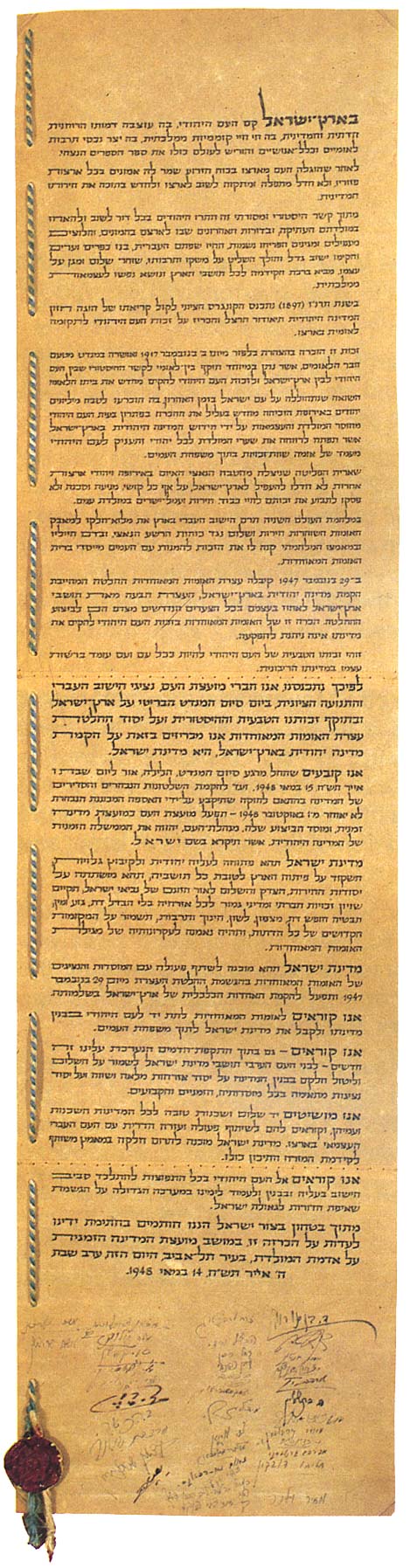
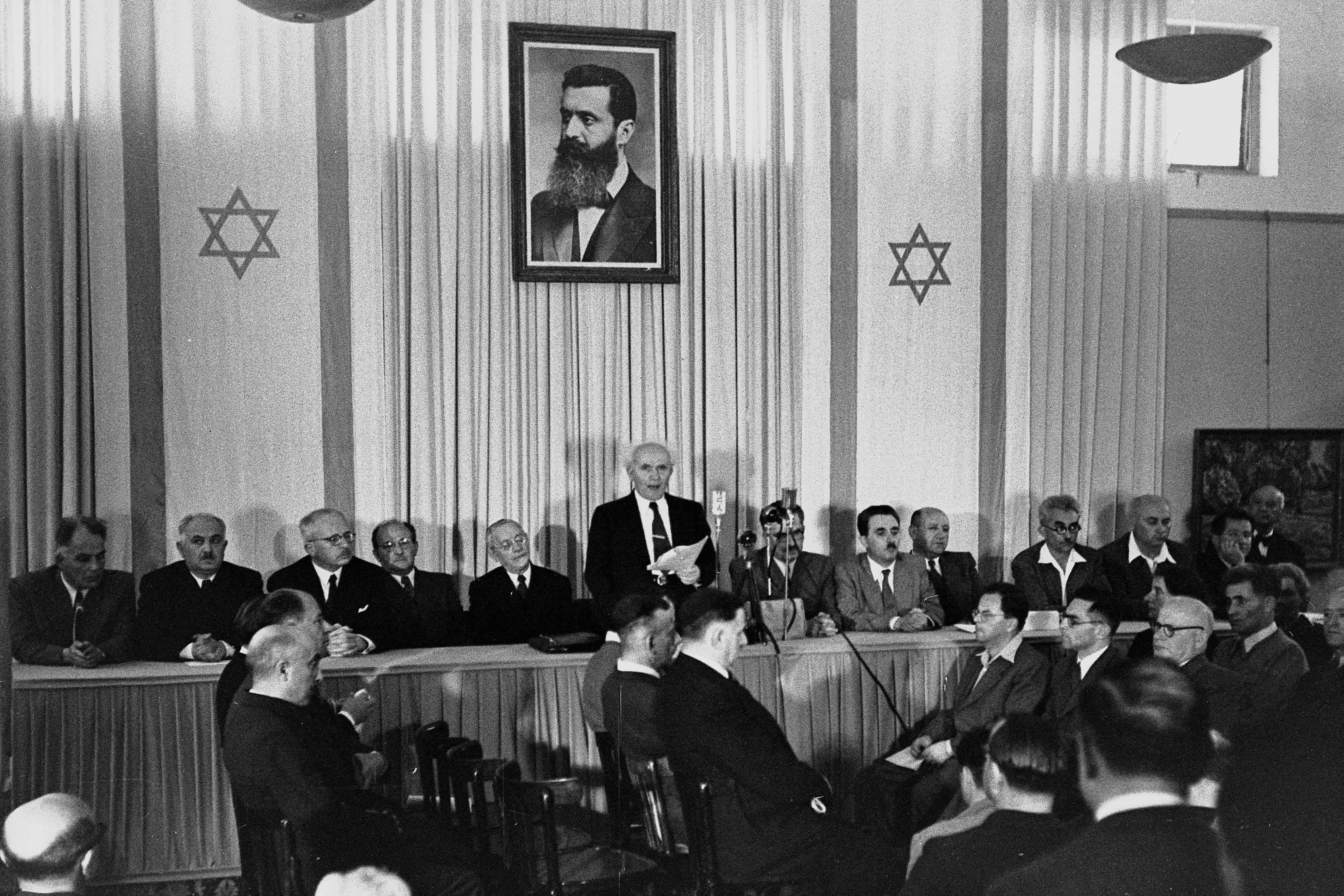
Fast forward a few months to the 5th of Iyyar, Friday May 14th, 1948. Debate raged in the Jewish council convened by David Ben Gurion about the new Jewish state’s Declaration of Independence. Religious members of this Jewish assembly insisted that this declaration mention the God of Israel while many secular Zionists opposed any mention of God. One political party insisted the declaration be signed at midnight when the British mandate officially expired. The religious parties asserted that such a situation would mean that the state would be “born in sin” and threatened to leave the convention as the Sabbath approached. A compromise satisfying both the secular majority and the religious delegates seemed impossible.
David Ben Gurion realized that to succeed any declaration of Jewish statehood required all the stakeholders to agree. He proposed that rather than refer to God, Israel’s declaration would end with a mention of placing trust in Tzur Yisrael, The Rock of Israel, a biblical term used as a synonym for God but one that could be interpreted differently by members of the assembly possessing a more secular outlook. [see Zionism: The Birth and Transformation of an Ideal,by Milton Viorst
available at https://tinyurl.com/39zvane2]
After being forcibly exiled from their land, the people kept faith with it throughout their Dispersion and never ceased to pray and hope for their return to it and for the restoration in it of their political freedom.
Impelled by this historic and traditional attachment, Jews strove in every successive generation to re-establish themselves in their ancient homeland.
~ Archeology supports the Israelite presence in the Land of Israel starting at 1200 BCE (with Joshua), because that's when the pottery changes. Does it matter?
~ This section doesn't refer to the Biblical covenant, where God says that the Land of Israel will belong to the patriarchs and their descendants (Gen. 12:7; 26:4; 28:13; Deut. 34:4 etc). Was it a good choice to leave that out?
In the year 5657 (1897), at the summons of the spiritual father of the Jewish State, Theodore Herzl, the First Zionist Congress convened and proclaimed the right of the Jewish people to national rebirth in its own country.
This right was recognized in the Balfour Declaration of the 2nd November, 1917, and re-affirmed in the Mandate of the League of Nations which, in particular, gave international sanction to the historic connection between the Jewish people and Eretz-Israel and to the right of the Jewish people to rebuild its National Home.
* specific word for immigrants coming to Eretz-Israel in defiance of restrictive British legislation
~ What new reasons for declaring the state are given in this section?
~ Why mention Herzl and the Balfour Declaration?
~ What new argument is being given in this section for why the state should be declared?
~ Why did the Shoah create an "urgency" for a Jewish state? Does that urgency still exist?
In the Second World War, the Jewish community of this country contributed its full share to the struggle of the freedom- and peace-loving nations against the forces of Nazi wickedness and, by the blood of its soldiers and its war effort, gained the right to be reckoned among the peoples who founded the United Nations.
~ Why mention the efforts of the Jews in the Yishuv against the Nazis?
This right is the natural right of the Jewish people to be masters of their own fate, like all other nations, in their own sovereign State.
ACCORDINGLY WE, MEMBERS OF THE PEOPLE'S COUNCIL, REPRESENTATIVES OF THE JEWISH COMMUNITY OF ERETZ-ISRAEL AND OF THE ZIONIST MOVEMENT, ARE HERE ASSEMBLED ON THE DAY OF THE TERMINATION OF THE BRITISH MANDATE OVER ERETZ-ISRAEL AND, BY VIRTUE OF OUR NATURAL AND HISTORIC RIGHT AND ON THE BASIS OF THE RESOLUTION OF THE UNITED NATIONS GENERAL ASSEMBLY, HEREBY DECLARE THE ESTABLISHMENT OF A JEWISH STATE IN ERETZ-ISRAEL, TO BE KNOWN AS THE STATE OF ISRAEL.
~ What are the responsibilities of a people who have their own state?
Up to here we had a sequence of reasons for founding the State of Israel.
Which one is the most compelling to you, why ?
Here's a summary:
The Tanach
Jewish history
anti-Semitism,
Zionism and the Hebrew language
the Shoah
the UN Resolution (11/29/47 - the Partition Plan)
the natural right of every people to have a state.
THE STATE OF ISRAEL will be open for Jewish immigration and for the Ingathering of the Exiles; it will foster the development of the country for the benefit of all its inhabitants; it will be based on freedom, justice and peace as envisaged by the prophets of Israel; it will ensure complete equality of social and political rights to all its inhabitants irrespective of religion, race or sex; it will guarantee freedom of religion, conscience, language, education and culture; it will safeguard the Holy Places of all religions; and it will be faithful to the principles of the Charter of the United Nations.
THE STATE OF ISRAEL is prepared to cooperate with the agencies and representatives of the United Nations in implementing the resolution of the General Assembly of the 29th November, 1947, and will take steps to bring about the economic union of the whole of Eretz-Israel.
~ What do you think "freedom, justice and peace as envisaged by the prophets of Israel" means?
~ Are the values in this section Jewish values? Are they important in the modern world? Why?
~ Is anything missing from this section?
~ What does it say about Israel that this section is included in its Declaration of Independence? Is there an inherent tension present in this section, or not, in your opinion?
WE APPEAL - in the very midst of the onslaught launched against us now for months - to the Arab inhabitants of the State of Israel to preserve peace and participate in the upbuilding of the State on the basis of full and equal citizenship and due representation in all its provisional and permanent institutions.
~ Are you surprised to learn that Israel extends citizenship to all Arab inhabitants of the sovereign state of Israel?
~ What responsibility does this give Israel? What responsibility does this give to the Arab residents?
~ What does it mean that Israel offered peace to its Arab neighbors in its first public statement?
PLACING OUR TRUST IN THE "ROCK OF ISRAEL", WE AFFIX OUR SIGNATURES TO THIS PROCLAMATION AT THIS SESSION OF THE PROVISIONAL COUNCIL OF STATE, ON THE SOIL OF THE HOMELAND, IN THE CITY OF TEL-AVIV, ON THIS SABBATH EVE, THE 5TH DAY OF IYAR, 5708 (14TH MAY,1948).
Israel asked the Jews of the world to rally by its side. What do you think this meant in 1948? And what do you think it means today? Do you feel the need to rally by Israel's side?
The section suggests that the "redemption of Israel" is ongoing and not complete. What do you think this means? Do you feel a part of it?
The term "Rock of Israel" was a compromise between those who did and didn't want God in the Declaration of Independence. Does the inclusion of this term make it easier or harder for you to connect to the document?
Noteworthy similarities and differences exist between the American and Israeli Declarations of Independence. Both declarations assert independence and the right of their populations to control their own destinies, free from legislative impositions and despotic abuses. In the Israeli case, however, immediate past history was included, and it reflected earlier Jewish catastrophes and the prospects of potential physical annihilation. Both declarations sought self-determination, liberty, and freedom, derived their claims based on human and natural rights, promised safeguards for the individual, and proclaimed an interest in commerce or economic growth.
The Israeli Declaration of Independence contained a list of historical claims to the land of Israel. The Declaration cited benchmark historical events when the international community sanctioned the Jewish state’s legitimacy, particularly the acknowledgement to build a national home given by the League of Nations (1922) and by the United Nations (1947) to establish a Jewish state. While there were skirmishes going on between Americans and the British when the American Declaration of Independence was signed in 1776, when Israel declared its independence it was in the midst of a full-fledged war for survival with the local Arab population and surrounding Arab states. The on-going war notwithstanding, the Israeli Declaration of Independence includes a declaratory statement offering “peace and amity” to its neighbors and the request “to return to the ways of peace.” Both declarations made reference to a higher authority: the Israeli Declaration of Independence does not mention religion, but it closes with the phrase “with trust in the Rock of Israel [Tzur Yisrael].” The choice of this phrase was Ben-Gurion’s verbal compromise, made to balance strong secular and religious pressures. Any precise mention of religion might have required mention of religious practice, which could have created enormous social fragmentation in the early fragile years of the state. By contrast, the American Declaration of Independence appealed to the “Supreme Judge, protection of the Divine.”
https://israeled.org/resources/documents/israel-declaration-independence/
(ג) אָמַר֙ אֱלֹקֵ֣י יִשְׂרָאֵ֔ל לִ֥י דִבֶּ֖ר צ֣וּר יִשְׂרָאֵ֑ל מוֹשֵׁל֙ בָּאָדָ֔ם צַדִּ֕יק מוֹשֵׁ֖ל יִרְאַ֥ת אֱלֹקִֽים׃
(3) The God of Israel has spoken, The Rock of Israel said concerning me: “He who rules men justly, He who rules in awe of God
(כט) הַשִּׁיר֙ יִֽהְיֶ֣ה לָכֶ֔ם כְּלֵ֖יל הִתְקַדֶּשׁ־חָ֑ג וְשִׂמְחַ֣ת לֵבָ֗ב כַּֽהוֹלֵךְ֙ בֶּֽחָלִ֔יל לָב֥וֹא בְהַר־ה' אֶל־צ֥וּר יִשְׂרָאֵֽל׃
(29) For you, there shall be singing as on a night when a festival is hallowed; There shall be rejoicing as when they march with flute, with timbrels, and with lyres To the Rock of Israel on the Mount of the Eternal.
(15) May the words of my mouth and the prayer of my heart be acceptable to You, O God, my rock and my redeemer.